Archive for Communication

Waterfallacy – There is no documentation in Agile

Mike Cohn placed a challenge on his blog for people to describe a Waterfallacy – “A waterfallacy is a mistaken belief about agile that has been caused by prolonged exposure to the waterfall process.”  This is to promote his new book – Succeeding with Agile.  I have found it very useful in my Agile work and would like you to consider ordering it now to succeed with Agile ;-)

I have run up against this waterfallacy many times. Here are some of the things I have heard:

  • “Agile is all about coding, not about documenting.”
  • “The Agile manifesto says documentation is not important.”
  • “How can you deliver software without a requirements document?”

The assertion is that there is little or no documentation in Agile and the implication is that Agile cannot possibly work.

How to overcome these statements?  I talk about 4 things:

  1. Agile manifesto – what it actually says
  2. Why Agile values face to face communication
  3. How Agile documentation works and how Agile teams document a lot
  4. If you are using Scrum, it’s up to the organization to define what is right.

Agile Values: Working software over comprehensive documentation

In the Agile Manifesto we talk about valuing working software over comprehensive documentation. So, working software comes first since that is what will make our businesses succeed. The manifesto does not say to avoid documentation entirely – that’s a mis-read!

Agile Principle: Use face to face communication

One of the key Agile Principles is:

The most efficient and effective method of conveying information to and within a development team is face-to-face conversation.

This signals that people should talk to each other rather than communicating through documents.  Does it say not to document?  No!

Agile Documentation – just the right amount

Agile teams tend to use wikis as a lightweight and searchable knowledge base. They document things that they think are important or useful. It may be text, photos, diagrams. For more info on how to make this work, check out this article on Agile Modeling.

Most of the Agile teams I work with produce a lot more useful documentation than more traditional teams I have worked on.

Scrum lets the organization decide how much to document

If you use Scrum, let me remind you that Scrum is completely silent on documentation. It’s up to the organization to decide how much and what types of documentation need to be completed every Sprint.

Usually people are convinced at this point and say – “Wow!  I didn’t know that.”

Leave a Comment

Powerful Questions and Powerful Requests

Finally, the last in my series of visual notes from Agile 2009. Not my best, but I wanted to share my thoughts about the session.

Lyssa Adkins and Tobias Mayer gave a practical and experiential session at the end of Agile 2009. Lyssa has written more about this on her blog. The original name for the session was Human-Centred coaching.

One useful trick (unrelated to the topic) is to raise one’s hand and wait for everyone else to raise their hands as a soft and effective way to get people’s attention.

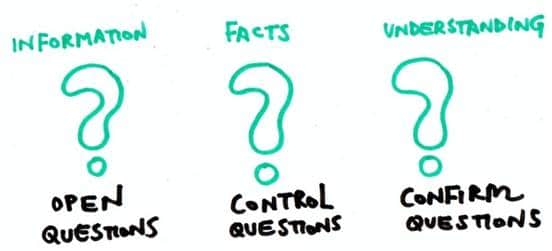
Powerful Questions

  • Are open rather than closed
  • Draw out hidden information
  • Lead people to new perspectives
  • Driven by curiousity
  • Give people time to respond

To get good at them you can write some new ones on cards every week and use them where they make sense. The book Co-Active Coaching has a section that discusses powerful questions. It is partly related to the NLP practice of using the Meta-Model to ask questions to reveal hidden assumptions.

Human Centered Coaching

Powerful requests

Some tips are written in light blue above.  This is similar to the core protocol Ask for Help.

Comments (3)

Visual Notes and MindMapping Supplies

Someone was asking what tools I use to create the visual notes and mind maps.  Perhaps the most important is to trust myself that whatever I am drawing is OK and will communicate ideas better than plain text.

I use the following supplies from DeSerres art store:

Visual Notes and Mind Mapping Tools

  • I like the Manga markers since they have really nice flow and give sense of grace.
  • The Staedtler fineline is good for adding lots of details and little pictures.
  • You can’t see it here, but the 8.5″ by 11″ sketch pad is perforated so I can tear off the sheets and scan them in.
  • I also sometimes use 11″ by 17″ sheets of paper with a Sharpie FinePoint for big picture thinking.

Visual note taking is a handy skill that I learned in a series of webinars: I only saw parts of this one and most of this one.  This is a good thing to do as a team/group activity.

Comments (1)

SMART goals may not be that smart

I just blogged about Daniel Pink’s case around intrinsic and extrinsic motivation.  This is a good lead-in for why SMART goals may be damaging to your organization.

SMART stands for:

  • Specific
  • Measurable
  • Achievable
  • Relevant
  • Time-bound

It is common management practice to tie employee ratings and annual bonus to the achievement of SMART objectives.  In light of the impact extrinsic motivators have on creativity, we must ask if this is really a good idea.  Bonuses or job progression that are linked to SMART objectives are extrinsic motivators, so we are going to end up killing creativity.  Oops.

I will go one step farther, and say that SMART objectives may be directly damaging to the organization since it provides unaligned goals for different individuals.

In the best case these are competing. I am working towards my goal and you towards yours.  Why would I want to help you since that will help you succeed and take away from my effort.  This been seen repeatedly in Agile teams where requirements for individual achievement undermine the team’s ability to function.

In the worst case actually conflicting.  For example, my goal is contrary to what is best for the company.  At that point I face the hard choice to do what is right and what is good for me.  I have seen this situation lots of times.  Managers in the company are provided specific goals that are not 100% in alignment with overall objectives.  That’s really the root of the problem.  Unless you can guarantee that goals (SMART or otherwise) are 100% in alignment with company goals you will run into this problem.  And even if goals are in alignment when they are created, what invariably happens is that there is drift in alignment as new information arrives.  Lean avoids this problem by focusing everyone on the top level company goal: profitability.  Anything else and your company will be wasting effort.

The last thing I’d like to touch on is what it means to be achievable. In IT, there is a lot of uncertainty about delivering software.  I have seen too many projects badly harmed by goals that have board level visibility.  With Agile projects there is some hope: work can be prioritized.  With more traditional projects, the common result is rushed work that leads to low quality and let’s of extra work and delay due to rework.  It can lead to compromised design, bad architecture, and a project that takes much longer than expected.

So watch out for SMART goals – they may not be.

Comments (2)

Taking Responsibility to Learn and Grow

Christopher Avery gave a very interesting talk at Agile 2009 called How to Develop Your Leadership Power Daily: An Agile Approach to Growth.  It was a very interesting talk about personal responsibility and how to grow – hence the title of this blog post.

Sidebar comment: This talk really has nothing to do with Agile so it appears that the conference program is branching out in new directions.  On the other hand, if you want to coach or build a high-performance team, then this is useful information.

Develop Leadership Power

The top left corner has the most important bit of information.  We are hard wired to not accept responsibility and would readily blame others.  As we are more self-aware we can progress from denial to blame to justification – all the way up to ladder to responsibility.   You can request a free poster here and there is a short description here.

The 3 keys are about how you can shift your own behaviour:

  1. Intention – intend to change your behaviour so you can win!
  2. Awareness – pay attention to your language and thinking.  Make a chart of how many times a day you can catch yourself not taking responsibility.  One way is to carry around change and give yourself a penny for noticing when you say something unresourceful and 10cents if you catch yourself before you say it.
  3. Confront – you need be honest with yourself or you’re not going to get anywhere.

The daily practices are some additional tricks to help move towards personal responsibility.

The anxiety hierarchy is about how some words you use when talking to others can trigger defenses.  Approaching someone about a PROBLEM will result in getting their input on a consideration.

As an NLP Master Practitioner, there is a note in the corner to remind myself that it’s not that easy to shift behaviour.  We often have limiting beliefs and values conflicts that may need some shifting in order to make a persistent change.  Awareness is a good start, but in my experience often not enough.

Comments (1)

Agile 2009 Mind Maps and Visual Note Taking

I have some really cool mind maps and visual notes from Agile 2009. These will take a while to get posted since I need to scan them when I’m back home (Still in Chicago to attend Lean training with Mary P) and then some time to upload and comment. There’s an RSS feed for this blog, so stay tuned.

Visual note taking is a handy skill that i learned in a series of webinars: I only saw parts of this one and most of this one.  This is a good thing to do as a team/group activity.

Leave a Comment

Use Desk Flags to protect your Pomodoro

A bunch of the folks I am working with now have started to use the Pomodoro Technique.  This is really cool and a great way to boost productivity.

One of the challenges is people interrupting because they don’t know someone’s in a Pomodoro.  So, one compensation (not a solution, just a mitigating technique) is to use … Desk Flags.

  • Flag up =  ”I’m concentrating – do not disturb.”
  • Flag down = “It’s cool to talk to me.”

Here you can see two people working, the closer person has a flag up.
One flag up, one flag down

The flags were ordered from DeskFlags.com and they sell this cool 360 degree “click-it” (red and white object in the photos below) that allows one to easily swivel the flags around.

This is how they are mounted.

flag-up

flag-down-2

As I mentioned before, this is a compensation for when people are working solo.  An even better compensation is pairing, but that another story…

Comments (2)

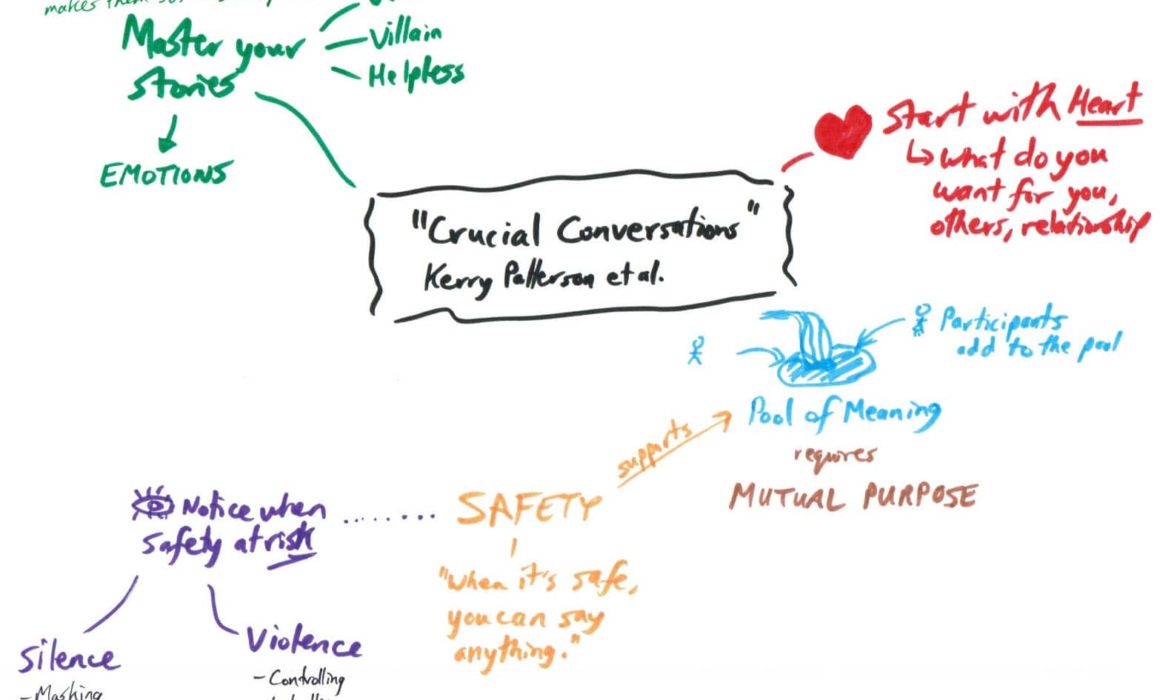
“Crucial Converations” helps in tough situations

“Crucial Conversations” was my book of the year a few years ago for a good reason.  It helped me with some very difficult conversations at work and at home.

I was reminded of this resource when someone I work with was suggested that this was an area of growth for her.  She was kind of annoyed, and then I reminded her that this is a great skill to develop.  I have been working on this for years and I still can do with more improvement.  So in my estimation, take any chance to develop communication skills since it pays off.  Bigtime.

I am not going to summarize the book here.  Instead you can check out a mind map I made up to summarize:  Crucial Conversations – Summary map – shared on www.biggerplate.com I made the mindmap up to help the team I am working with.  Feel free to share it with yours.  Anyway, a few days later, I had an opportunity to use these techniques on my own crucial conversation and turned a very sticky situation into opportunity.  Not sure if it’s a happy ending yet…

If you are in Toronto/GTA, and interested in improving your communicatino, then you might even want to consider a workshop with Innergize Training on Workplace Conflicts And Handling Sensitive Issues.

Leave a Comment


       Certified Scrum Coach Certification
         XPToronto and Agile User Group