Archive for Culture

10 Things Executives Need to Know about Agile

Slide deck with the top 10 things executives need to know about Agile:

Here’s the list with some handy links:

  1. Agile Is Mainstream
  2. Many Benefits from Agile
  3. Agile is not a Silver Bullet
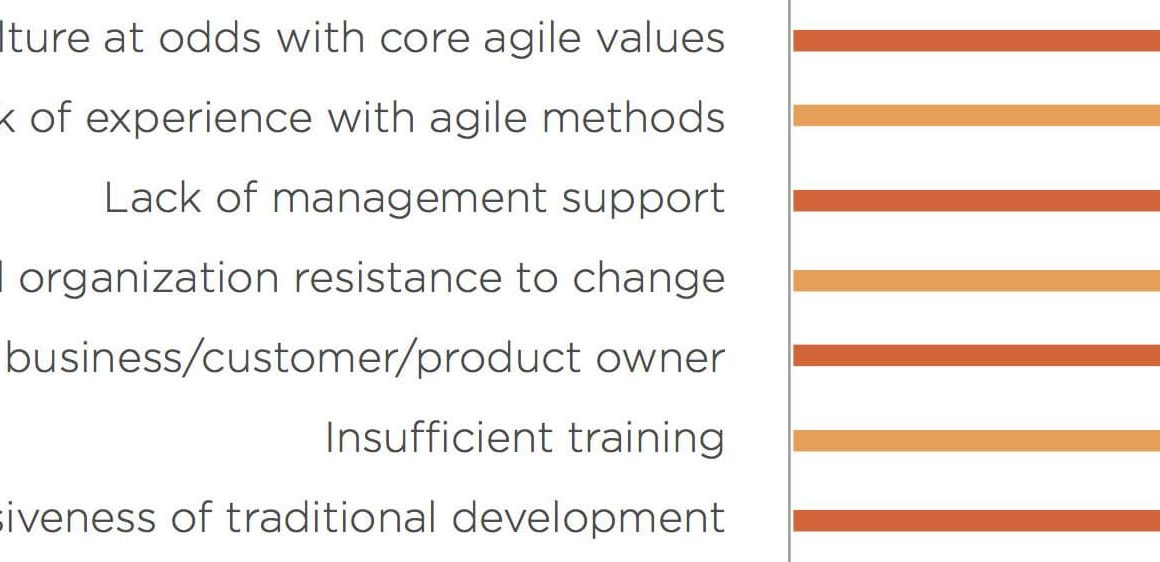
  4. Agile Fails Due to Culture
  5. Agile Differs from Most Company Cultures
  6. Most Value Comes from Mindset/Culture, not Practices
  7. Adopt Agile Practices that fit Culture (Option 1)
  8. Change Culture through Organizational Transformation (Option 2)
  9. Culture Mismatch will Slow and Ultimately Fail Your Agile Initiative
  10. Culture Eats Strategy for Breakfast

Of course, it is fine to proceed with either option – adoption or transformation – it’s about what is the best fit for the client environment and their wishes.

There are two conversations around transformation that this deck is designed to trigger/encourage:

  • What does break-through organizational culture look like?
  • What does organizational transformation look like?

My Favourite Slide in the Deck

Benefit of Practices vs Culture

Acknowledgements

I would like to thank the hundreds of people who have attended my workshops and talks over the last two years to help clarify and refine this message.

Print Friendly

Leave a Comment

How to Build a Culture Bubble

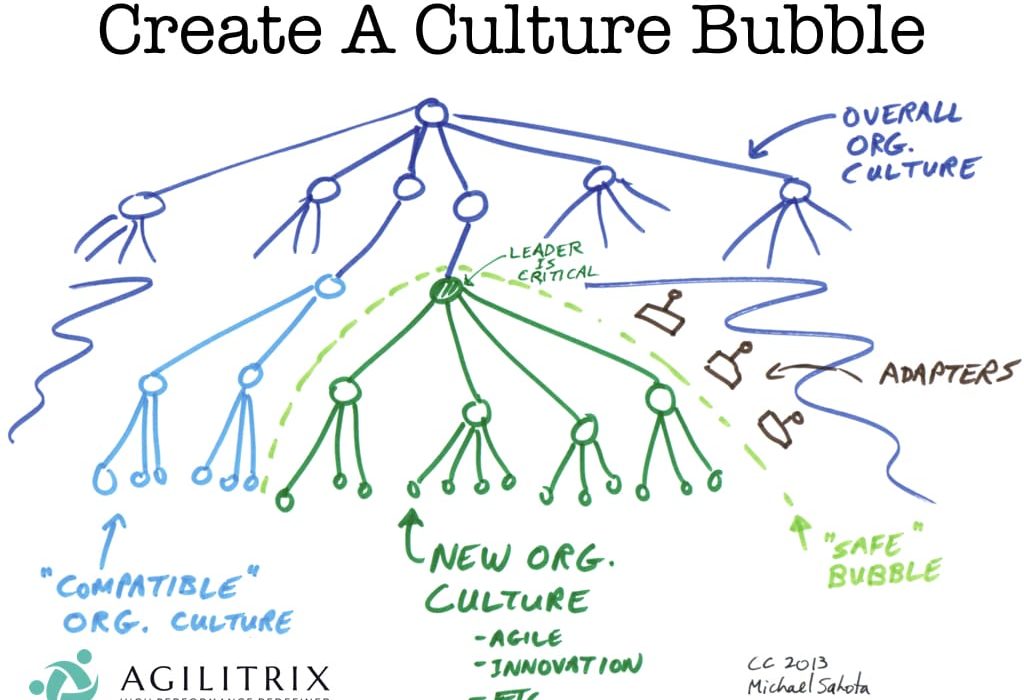
The post is about how one can create a bubble of a new culture inside of an existing organization. For example, this may be used by a group interested in developing an innovation and learning culture inside a typical bureaucratic organization. This post is a continuation of my earlier post on how to Build Culture Adapters to Avoid Agile Failure.

I realized that I have drawn the diagram below dozens of times with clients, prospects and colleagues over the last year and realized other people may be interested in it.

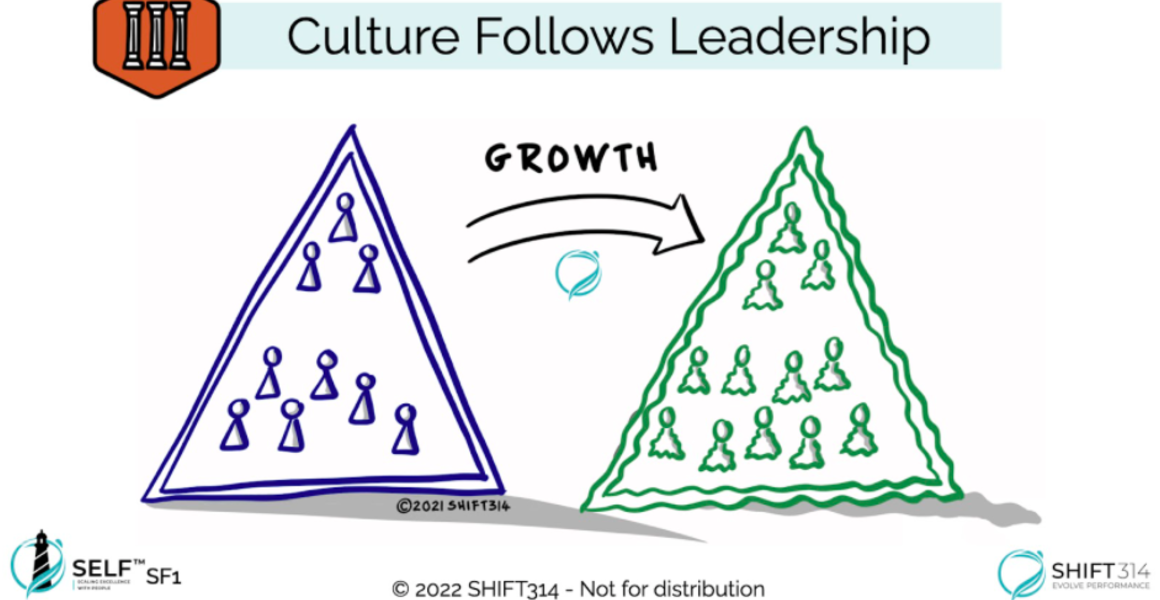
The drawing below shows the hierarchy of a typical organization with a dominant culture (in blue) and a new culture bubble formed (in green).

Leader growing different culture in org hierarcy

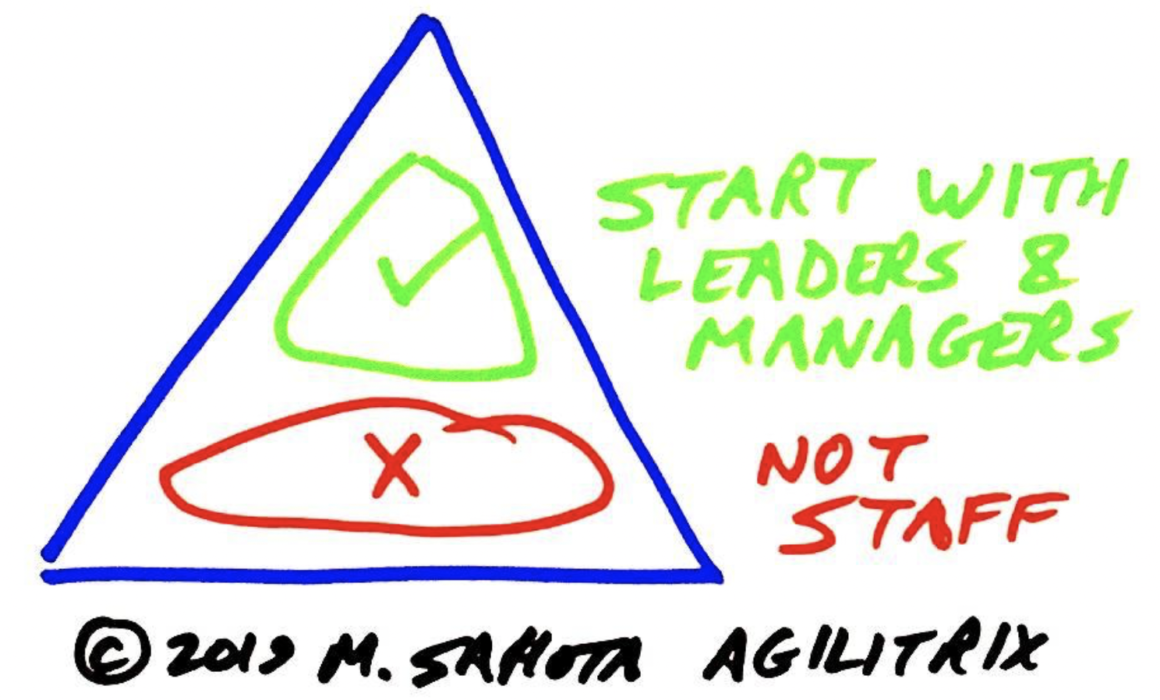
Given the nature of a power hierarchy in traditional organizations, a leader/manager can induce a culture shift in the organization that reports into her. See Transformation? Leaders Go First! for an explanation of how leaders can support a transformation process.

It is of course, critically important to build adapters around your bubble so that it can safely interface with the rest of the organization and avoid trigger the attack of organizational anti-bodies.

A final comment is regarding the cooperation of partner groups (in light blue) that are tightly bound to the same customer value stream. The close cooperation required for success necessitates a higher level of alignment. This means that the partner group must either help lead the culture change (and go green) or at a minimum be neutral (as show in light blue).

In a software context, a very tight relationship exists between the product and development groups since they need to work together to create customer value. A common pattern is for the green bubble to be the development and the blue bubble to be product.

When and How to Use This Diagram

I typically draw this picture and provide this explanation when socializing alternative approaches to Agile. In virtually all cases, the change agent leading the Agile initiative is not the CEO and does not have a span of control or influence over the whole organization. It is usually the case that typical “modern” management practices are in place that are regressive and hostile to fostering an Agile culture. So most leaders have the option of sticking to the adoption of practices that are consistent with the existing organizational culture or undertake a transformation of their group to realize a new culture that is supportive of Agile.

It is of particular importance, that as an external change artist, we are fully respectful of our client’s wishes and intents. It’s their organization after all. For some coaches this means letting go of the dream of helping the organization move forward on the road towards an Agile mindset – or “real” Agile.

Related Work?

Some time ago I shared George Schlitz and Giora Morein’s Agile Enablement Battlefield model to help understand how a transition is progressing. I am no longer a big fan of the metaphor of war, however, the notions of “fog of war” can be helpful. As well, I have seen increasing danger and harm caused by wolves in sheep’s clothing. These are the folks who say they are on board and go along with changes, but resist in passive ways. Of course, this is a natural and understandable response to coercion. If we really want to change our organizations then coercion is a tool that we need to leave behind.

Acknowledgments

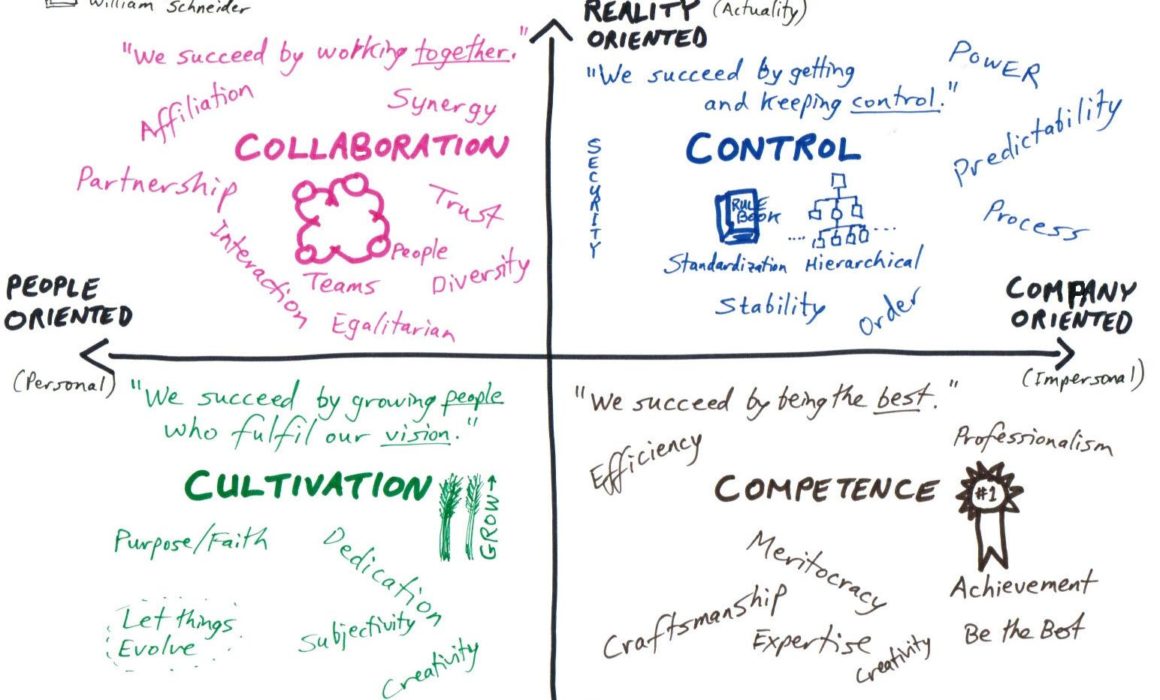
The basic ideas of managing gaps in culture comes from William Schneider’s book How to Make you Culture Work. Many thanks also to all the various workshop participants who validated that these patterns apply.


Print Friendly

Leave a Comment

Build Culture Adapters to Avoid Agile Failure

The purpose of this post is to explain why building culture adapters around at team or group is a good idea. It is important for me to revisit this topic from my book and conference presentations since I have learned something new and wanted to share it. All but the last section is an excerpt from my book.

It is by now well known that Agile is a mindset and culture system and that it is incompatible with most organizational cultures.

Let’s talk about one way of moving forward with Agile – building adapters. This is an effective approach when the span of control and influence of the leadership does not cover the whole of the organization.

Start with A Successful Agile Team

A very powerful way to think about introducing a foreign culture such as Agile to an organization is through a cellular model. Consider a successful transformation of one team or group to Agile. This may have been a special pilot project with all the people keen to do Agile.

Imagine that the team is very excited about the new way of working. The team exists in the context of some other culture.

Team+Culture - 1 Cell adaptor Model

The team is not that excited about all of the organizational barriers and limits on productivity and success. So, what typically happens is they start to push back on the needs and requirements of other groups that are not adding value to the team and to the customers.

Attack of the Organizational Antibodies

The result sounds like a B-movie: “Attack of the Organizational Antibodies!” In the human body, we have antibodies (Killer T-Cells) that are designed to eliminate foreign elements to keep us healthy. In a similar way, organizations will react to the introduction of a foreign culture system such as Agile. These are the elements that work hard to preserve the status quo.

Team+Culture - 2 Anti-bodies

Build Culture Adapters

The movie doesn’t have to have a bad ending. One common pattern is to build adapters or translators around the foreign culture so that it fits within the overall culture. These are depicted in the diagram below as shapes surrounding and protecting the team. In this situation, the adapter allows the team to blend in with the overall organizational culture and avoid triggering the antibodies.  It looks like this:

Team+Culture - 3 Barriers + Adapters

In practical terms, the adapter could take the form of a Microsoft Project Plan that has no value to the customers or team but is required by the organization. Another might be team use of a peer-based review for merit increases that still gets submitted by the manager since the system requires input only from her.

This sounds like a lot of effort! Is it worth it? The value is equal to the benefits derived from Agile less the cost of adapter maintenance. Assuming there is good value in the team’s new state of functioning, then sadly some of that productivity will be lost maintaining the adapters. But this is a much better situation to be in compared to getting attacked by organizational antibodies. The adapters are part of the cost of doing business. Like taxes.

Lean differentiates between different types of waste in organizations. Type I Muda (waste) are non value added tasks that are required at the current time. Type II Muda are non value added tasks that can be removed immediately. Maintaining the adapters is type I since the environment requires them.

The model above points a way to success with Agile transformation – it is possible to transform one team or group provided that care and attention is provided to satisfying the requirements of the larger organization. It is a feasible strategy to consider this a first step before a wider organizational change initiative.

THIS WILL EVENTUALLY FAIL!

The adapter strategy is not sustainable in the long term. Why? Eventually, the manager of this group is going to leave and a new manager will be selected. The new manager will typically be chosen to reflect the host organizational culture and will become a powerful attractor for the host culture. An then Agile gets dissolved or neutered. And the people who love working in this new way to deliver great products quit the organization and go work somewhere else.

At a number of conference presentations, I presented the arguement that no responsible manager should undertake using this pattern since it is ultimately doomed to failure. And this is my mistake. I was wrong. Sorry.

But that’s Good! (My New Insight)

I was at a client earlier this year and this topic came up. As I have been working very hard on supplicating and having compassion for the organizations I coach, I noticed something interesting. This particular organization was focussed on short term results and not long term results. (Yeah, I know this is a losing strategy but it’s their culture not mine). So, in the context of their organizational culture is was not only acceptable but highly desirable to do something that will work in the short run but fail in the longer term. So, if you are a manager in an organization that is fixed on short-term results, then the adapters are a truly great strategy to use with a clear conscience. Happy trails.


Print Friendly

Leave a Comment

Connecting the Dots on Agile, Org Culture, Personal Growth & Temenos

A friend of mine asked me what is going on with all this touchy-feely people and personal growth stuff – “What’s it got to do with Agile?” My answer: everything! So this post ties together: Agile, High-Performance Culture with People skills and Temenos Workshop among others.

Here is my current roadmap of focus areas related to rebooting organizational culture:

Culture Reboot Roadmap


The arrows indicate support. For example, People Skills such as communication models lead to Relational Flow where people trust one another and are emotional supportive. This in turn leads to or supports High Performance Culture.

High Performance Culture is the Goal, but Need to Focus Elsewhere

My goal is to help organizations develop high performance culture through the creation of environments where people can bring their best every day. We can see there are a variety of things to focus on that will lead to support this goal.

Let’s take meditation as an example. There is no direct connection to high performance culture – it’s indirect. But in my experience it is 100% relevant and salient for bringing about a sequence of changes that support the goal. So, we need to focus on the things that will lead to a great culture and the ensuing results. Of course, there are many routes and practices – so nothing is mandatory: meditation works for me, but you may have an alternate route to personal growth.

This is not an exhaustive map of all the elements that lead to High Performance Culture – for sure there are lot’s of things we could add. My purpose in creating and sharing this is to create a call to action to focus on these or related elements so that we can really help organizations succeed.

Examples of Posts on these Topics

My hope is that you are curious about some of these content areas, so I will share some of my blog posts for further reading.

What is High-Performance Culture?

Relational Flow

People Skills

Personal Growth

Organizational Transformation

Transformational Leadership

Temenos Workshop

Print Friendly

Comments (2)

Diverse Paths to High-Performance Organizational Culture

There is no single path or prescription for high-performance organizational culture. Increasingly companies are abandoning the traditional “modern management” practices developed for manufacturing and are moving to post-modern approaches that reflect the changing face of work and  the needs of knowledge workers.

In this post, we compare and contrast five organizations that have moved beyond traditional (archaic) management practices: Zappos, Valve Corporation, Semco, Netflix, and Beyond Budgeting Companies. The results are shown in the matrix below using Harvey Balls:

Comparison of High-Performance Organizational Cultures

As can be seen that for many aspects these organizations, there is no single best way. It can be seen that there are many paths to effective organizational cultures. At the level of individual practices we can see that there is great diversity.

Customer Focus and Engaged Staff

There are two very powerful common threads that emerge around these organizations: customer focus and engaged staff. Although each organization has a unique cultural operating system and supporting practices, they all share this commonality.

Organizational Coherence

Each organization has a powerful driver for coherence around values and behaviour. We consider each of the methods identified in the image below to be roughly equivalent in the sense that perform the same function – namely organizational coherence. In other words, simple rules of behaviour in one organization may be functionally equivalent to values in another organization in terms of it’s ability to guide and unify. Each organization has different values and principles, so this would suggest that there is no one path to success.

Values

Future Investigation

The diagram below is a brainstorm of additional organizational aspects to consider as well as other organizations the have characteristics of post-modern thinking.

Organizations and Aspects

I have recently discovered that Lululemon is another example of break-through organizational culture.

Acknowledgements

I would like to thank the participants in this session: Don Gray, Claudia Melo, Jens Coldewey and Diana Larsen. I would also like to acknowledge the financial contribution of the Agile Alliance for sponsoring this workshop through the Supporting Agile Adoption Program.

Print Friendly

Comments (2)

Workshop on Characteristics of High-Performance Organizations

At Agile Tour Toronto last November, I conducted a workshop to get crowd-sourced research into high-performance organizational cultures. The purpose of this workshop was two-fold. First, to understand similarities and differences between organizational cultures. Second, to see if case-studies of high-performance cultures would resonate with Agile-oriented people.

The companies that were selected for study were:

  1. Zappos – amazing customer service
  2. Valve Corporation – everyone responsible for finding a project to contribute to (no hierarchy)
  3. Semco – where people pick their own salary and people choose their managers
  4. Netflix – where staff are managed like a professional sports team – only the best and non-performers are cut
  5. Beyond Budgeting – OK, this isn’t a company, but we used the composite characteristics of companies that move to decentralized control. It’s more about leadership than budgeting.

Each group was given a case study, and asked to summarize the following:

  • Key Organizational Characteristics – What did the organization pay attention to and how did it structure itself?
  • Business Benefits – What material business results were observed in that organization?

Happy Customers and Engaged Staff

When asked what the key benefits these companies found from their high-performance culture the aggregate results across all companies were happy customers and engaged staff. See image below. We played a short version of the game of 35 to arrive at this result.

Key Benefits of high-performance cultures


With regard to the second goal of the workshop – the workshop participants were very interested and several indicated that they found learning about these cultures as valuable for understanding how to progress with Agile at an organizational level.

Zappos Characteristics and Benefits

I have photos of the results of some of the groups, but the lighting was terrible so it’s really hard to read. Below are the results for one group that was working on Zappos.

Characteristics:

  • Focused on long-term vision
  • Customer oriented
  • Fun and a little weirdness
  • Team communication
  • Personal and professional growth

Benefits:

  • Delighted and repeat customers
  • Employee retention
  • Long-term growth
  • Positive financial outlook
  • Better ROI

Acknowledgements

I would like to thank all the participants for working together to understand each organization’s structure and to identify the key benefits. Based on the ratings and comments, it looks like people had fun.

I am very grateful for Thiagi for showing me how to create a great workshop out just some handouts so that I can get out of the way and let people learn directly.

Print Friendly

Leave a Comment

Relatedness trumps Responsibility, Accountability

Relatedness is the heart of high-performing teams and organizations. As stated in the Agile Manifesto, focus on “Individuals and Interactions” is essential. How we relate to ourselves and others is central to creating and maintaining effective and valuable systems.

There are many mental frames that are used to discuss organizational culture and performance. In this post, I argue that relatedness trumps responsibility and accountability as a meme for change. All are valuable and necessary, however, focus on human beings and their relations provides the greatest leverage.

The diagram below illustrates this hierarchy.

Relatedness Responsibility Accountability

Relatedness

Relatedness is the connection between human beings in a system.

We can describe a system as the aggregate of all the interpersonal relations. Environments of trust and safety have a high degree of relatedness between people. These are the kinds of systems that we want to create for ourselves. We do this by connecting with others and helping people in groups connect with each other.

There are myriad ways to create relatedness. Simple ones include sharing food or drink. Working together on a shared goal can support this. Simple exercises such as Marketplace or teambuilding with Lego can move us towards greater relatedness. Another is the Check-in protocol where people share emotions. Improv theater has expected behaviours that support relatedness: yes-anding, making everyone else look good, mistakes are invitations to create, etc). Zappos has fun as part of company culture and uses events and activities to create connectedness. e.g. Head shaving for charity.

Approaches exist for dramatic improvements in relatedness. Temenos is a retreat/workshop designed to help people see themselves and other participants as whole and valuable human beings. Other approaches include organization-wide mindfulness practices and mediation to re-wire our brains to focus on the present moment as well as to what is going on at an emotional level with ourselves and with others.

Recently, I have been writing about the work of Brene Brown and how attention to our internal emotions and thoughts helps us connect with other human beings. See related posts on empathy, vulnerability and shame.

Responsibility

Christopher Avery views responsibility as the core to success. We want environments where people feel a sense of ownership and responsiblity for creating successful outcomes. Individuals that feel responsibile are an essential compenent of a high-performing systems: they will notice what needs doing and make it happen.

So why is it often better to focus energy on relatedness versus responsibility?

A system where people have a high degree or relatedness will strong foster responsibilty. People will be motivated to take action because they care and understand about the impact on others. So when we start with relatedness, responsibility will follow. It is also the case that relatedness will increase when people act with responsiblity, but this is not as strong an effect.

Both relatedness and responsibility are valuable. When it is appropriate to cultivate relatedness in a system, then this will set a stronger foundation for system health and growth.

Accountability

There are some who argue that accountability is the key to greater performance. One example of this is Change the Culture: Change the Game where Conners and Smith explain how accountabilty can be used to increase organizational performance. There are lot’s of valuable contirbutions from the book discussion culture change, however, the central tenet “The most effective culture is a culture of accountability” is not aligned with more recent notions of organizational design and culture.

Tobias Mayer has a great post where he clarifies the tension between responibility and accountability. Tobies shares this quote : “There’s no word for accountability in Finnish,” said Pasi Sahlberg, one of the chief architects of Finland’s successful school reforms. “Accountability is something that is left when responsibility has been subtracted.

Although, accountability is required and a direct focus on accountability will get positive results in most dysfunctional systems, this  is not the full story. If we want a high-performance system, however, the best way to get accountabilty is by cultivating relatedness and responsibilty. Direct focus on accountability is hazardous to more evolved human systems.

Acknowledgements

I would like to thank those who have helped me on my journey to understand human relatedness as central to high-functioning systems. In particular, Siraj Sirajuddin, Pascal Pink and Olaf Lewitz have been powerful influences. I would also like to thank the participants of Temenos workshops for cultivating my ability to deeply connect with others.

Print Friendly

Comments (6)

Why We Need to Care About Empathy

There is a really great RSA animated video explaining Jeremy Rifkin’s idea of the Empathic Civilization. He argues that we are neurologically wired for human relatedness and empathy through mirror neurons: we are soft-wired for sociability, attachment, affection and companionship – we have a deep drive for belonging.

Epathic Civilization - not Aggression.tiff Epathic Civilization - Sociability.tiff


Rifkin believes that we need to cultivate empathy to survive and thrive as a species. We can do this by extending our empathy to the entire human race. Over our history as a species, empathy has grown in scope from: blood ties –> religious ties –> national identity. We just need to extend one step further to embrace the whole world.

Enjoy the video.

People, Profit, Purpose

I like how Rifkins’s ideas are aligned with the triple bottom line of people, planet, profit. When we focus on building high-performance organizations by cultivating empathy skills (profit motive), we also better ourselves to help the people around us and the planet as a whole.

Print Friendly

Leave a Comment

Hierarchy = The Matrix

The hierarchy is at the very center of our lives. We have experienced it in our school years and later when working in organizations. It’s existence and function is tacit in our understanding of reality.

At the Agile Alliance Change Agents workshop in Chicago in November, it became clear to me that the existence of hierarchy was greatly influencing the sessions. I sensed that there were two broad themes that emerged from the sessions.

One theme was around exploring Agile in the Enterprise. In this context, hierarchy was assumed. And much of the attention and energy seemed to be about finding ways to rise above and minimize the constraints it imposed. For example, how to shift focus on end-to-end flow.

Perhaps, the most insidious aspect of this is that our default assumptions around the hierarchy – it’s existence and requirements form the context of our thoughts. Just like how people are constrained to perceive reality in the movie the Matrix: we do not see or question it.

A second theme that emerged was around considering ways to create workplaces of joy – environments that foster an Agile mindset rather than constrict it. Agile provides a clear compelling model for organizing work and people. It does not, however, address the problem of organizational design: how to hire, promote and fire. How responsibility and leadership is enacted and enabled. This is an open problem. Included in this theme are questions such as team self-selection vs. deploying known patterns (e.g. Scrum). We need to find solutions to this so we can escape the Matrix.

Acknowledgements

First and foremost, I would like to thank the Agile Alliance for sponsoring this workshop and Diana Larsen for inviting me. I would also like to thank the whole group since these themes were an emergent result of all our combined questions, sharing and curiosity.

As a caveat, I am not trying to summarize all that happened, but rather provide one perspective.

Print Friendly

Leave a Comment

Tactics, Strategy, & Culture – A Model for Thinking about Organizational Change

The following diagram is a powerful mental frame to help understand change efforts within organizations. It makes the discernment between tactical, strategic and cultural levels. One way to use the diagram is to position each change item or activity on the line to show what aspect it is focussed on.

More importantly, I use the diagram to engage with clients to explore what they want to achieve, why they want to achieve it, and how invested they are in the outcome.

Some typical benefits are listed above the line. Most importantly, break-through results only come from culture –  not tactical or strategic approaches.

  • Tactics – “How do we work?” is about day to day practices and process elements. These are things that a team or organization can adopt.
  • Strategy – “What do we want to achieve” is about aligning the company around key goals and initiatives.
  • Culture – “Who do we want to be?” is about clarifying the organizations reason for existing as well as it’s values and vision.

Relationship between the levels

Culture is the foundation that Strategy and Tactics sit on. But culture is like an iceberg – a powerful force that is underwater where you can’t see it. Sure it’s possible to work at the levels of tactics and strategy, but that is unlikely to make any lasting change or draw great benefits. Lasting change requires working at all three levels so that the tactics and strategy support the culture.

Relationship to Leadership Agility

Bill Joiner has identified a number of distinct mindsets that can be found with managers/leaders. and his work on Leadership Agility. The following are one to one mappings from types of leaders/mindsets:

  • Experts focus on Tactics: problems and work execution.
  • Achievers focus on Strategy: outcomes and the system.
  • Catalysts focus on Culture: vision and break-through culture.

Acknowledgements

The deepest inspiration comes from Bill Joiner and his work on Leadership Agility and the different levels of focus. This served as the basis for my model.

I would like to thank a variety of sources for the notion of Culture being mostly hidden – I have seen or read this in a number of places but most vividly from the folks at Crucial Conversations and their book Influencer in particular.

I am grateful for Mike Cottemeyer for helping me understand the difference between Agile Adoption (Tactical) and Agile Transformation (Cultural).

Print Friendly

Comments (4)