
Archive for Management

How to Make Your Culture Work with Agile – Screencast

Here is a video primer of the Schneider Culture Model and how Agile, Software Craftsmanship and Kanban fit in. It is recorded in HD so you may want to use full screen and 720p resolution to see all the slides.

For more information, please see Agile Culture Series Reading Guide.

Print Friendly

Comments (9)

Ways to Make Progress with Culture Gaps

In an earlier post, I talked about how Agile Fits Better in Some Company Cultures than Others.

In this post, we’ll review some common strategies for handling cultural mismatches.

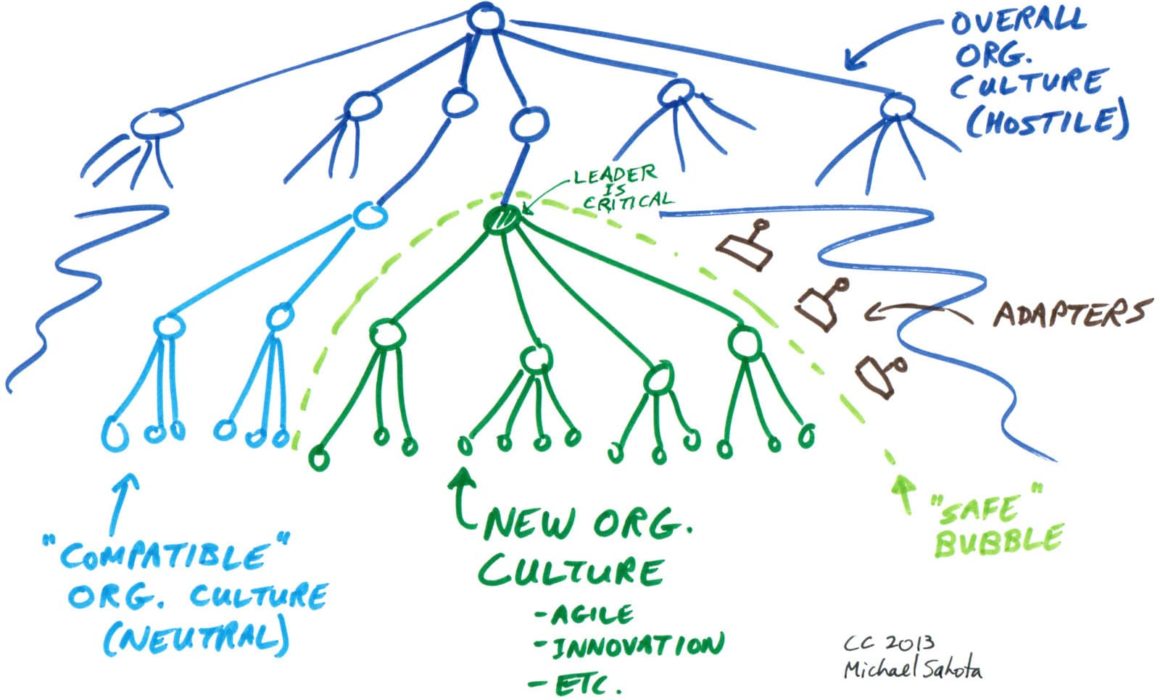
The Big Pitcure

I almost posted this blog without a summary picture and I am glad I stopped myself. Once I made the drawing below, I saw there are two main strategies (adoption and transformation) and sub-strategies within them. This post will walk you through the options and when to use them.

Work with your Culture

This is the recommendation from Schneider’s book – How to make your Culture work: work with your culture; don’t fight it. I’ll outline some ways below.

#1 Build on Your Current Culture

The idea here is pick an approach that is compatible with the current culture of the organization.

One way I interpret the diagram on the right (see related article) is a prescription of what aspects of Agile/Lean to focus on based on company culture:

  • Control Culture? –> Lead with Kanban
  • Competence Culture –> Lead with Craftsmanship
  • Collaboration or Cultivation Culture –> Lead with aspects of Agile that align with the organizations culture. e.g. Vision and Retrospectives for Cultivation Culture.

Kanban? But it’s not Agile!

Some really smart Agile folks think than Kanban is a sell-out: That it is a watered down, inferior form of Agile that doesn’t measure up. (I mostly disagree with this sentiment).

This reminds me of a story Craig Larman shared at a local user group meeting: “My favourite process is Unified Process. I do it in a very Agile way. But, I never recommend it to my clients since it is too easily interpreted as Waterfall and they won’t get the benefits. Instead I use an explicit Agile method. It’s not my preference, but I use it and it is better for my clients.” So, even if you like Scrum better, your client may thank you for helping them with Kanban.

So my view on the topic is that it doesn’t really matter which is better in some abstract sense. All that matters is what will help this client the most and make peoples lives better. See Kanban is a Gateway Drug for more thoughts on this topic.

#2 Work with Compatible Cultures

Consider the diagram to the right. It shows that although the easiest option is to work with the existing dominant culture (in this case Control) it is possible to explore adjacent cultures since these are more aligned. Choice of direction may be guided by what the secondary non-dominant culture of the organization is. The idea here is to work with the culture, and not go against  the grain.

#3 Create Adapters between Different Cultures

Another way to handle this problem of cultural mismatch is to create barriers between different cultures. The idea here is to create a firewall or facade that lets the different cultural groups function with little friction.

Israel Gat talks about creating a boundary object such as automated tests and technical debt measurements to avoid conflict between development (collaboration) and operations (control). For this, and more on ways that you can make your culture work see Israel Gat’s presentation and conference session.

Joseph Pelrine has a great video on InfoQ – Dealing with the Organizational Challenges of Agile where he talks through some models including using people as buffers (Scrum Master) to translate between internal team culture and the external culture of the team. This is an amazing video that goes into much more theoretical arguments well beyond culture, so consider watching the full one hour.

One successful pattern I have seen is for Agile teams to create Gantt charts to keep the PMO happy. In some companies, this is necessary waste. It brings no value to the organization, but it is currently required for the organization to function. Of course you could stick to your principles and refuse, however, you may find that when the organizational antibodies that attack, they are stronger than your management support. Or it’s not worth the fight at this time.

Change your Culture

OK, this is hard. Really hard. Culture is singularly persistent in organizations.

What about Visionary Leadership?

Conventional wisdom is that innovative companies with visionary leadership can also transform to Agile. This is why you will often hear Agile coaches say that you need strong management support. But is this true?

Some people might point to the success of a company like SalesForce.com as an example of how they were able to change their culture. On the other hand, in the article Six Common Mistakes that Salesforce didn’t make, it is stated that “The leadership saw the transformation not so much as a wholly new approach, but rather a return to the firm’s core values.” So, this would then not be an example.

I vaguely recall a similar story about getting back to the original culture with Yahoo, who also did and enterprise transition to Scrum.

If you have any case studies, please feel free to share via email or comments.

Welcome back, Kotter

No, I’m not talking about the TV show. I’m talking about the Kotter model of organizational change. It recognizes the eight stages that are seen in successful organizational change efforts.

Some coaches in the Agile community are aware of the Kotter model and a few are actively using it to help companies achieve an Agile mindset. I am not aware of any case studies where a company has undergone transformation to Agile using this model (but we don’t do a good job as a community collecting case studies so it is unclear how heavily to weight this).

So, if you are thinking about changing company culture, this is pretty much the only clear transition model available. And yes, if you are a coach, you do need to understand organizational development to do your job well. Sad, but true.

So what?

As a coach, you need to know what game you are playing. Are you helping management transform their organization or are you helping them adopt a culturally-fit approach? Hopefully, you are not rolling the dice with inspect and adapt.

Print Friendly

Comments (1)

Sustaining Agility Game

Have you been on a software project where each release gets harder and harder? Many projects fall into the tar pit of the Design Dead Core.

Why do nearly all software projects fail to balance short term choices with long term consequences?

Through game-play you will experience how hard it is to make effective choices. Game learnings will be tied into well-known models in and beyond software such as Technical Debt, Stephen Covey’s Production Capability, and Alistair Cockburn’s theory of competing games.

Recipe

  • Game Objective: Participants experience the attraction of short-term thinking and feel the long-term consequences. The game helps executives and managers understand the importance of investment in sustainable development practices. The game is intended to help them get through a Red Pill, Blue Pill moment.
  • Number of participants: 6 to 50 (Has been playtested with 40 at XP Toronto User Group Meeting).
  • Team size: 3 to 5 people per team.
  • Duration: 90 to 110 minutes
  • Materials: Game cards (can print or write by hand), pennies (15 per team), dice (two per team)
  • Setup: (optional) video projector, tables for group work, whiteboard or flipchart.
  • Credits: This game was created by Alistair McKinnell and Michael Sahota.

Session Timetable

  1. Intro & Motivate Game [3 min]
  2. Break into teams of four or five people. [2 min]
  3. Setup Game [5 min]
  4. Year 1 [30+ min]
  5. Year 2 [20+ min]
  6. Year 3 [15 min]
  7. Debrief [15 min]

There is a backdrop story that motivates the game situation and is used throughout the game to provide entertainment and inject new rules.

What’s Your Choice?

Here is a photo showing the project choices available to management teams:

Game Narrative

You’re working at a large organization. (Although situation entirely applies to smaller companies). Your goal in this game is to get promoted within your organization through delivery excellence. You need 50 Career Points to get promoted.  You’ll keep track of your Career Points as the game progresses.

Together with the other people on your team, you form the management team of a software development division. Your team is competing with other teams to get promoted.

[Handout Steady and Fast Cards and Scoring Sheet]
[Each steady project generates $3M revenue. Each fast project generates $4M revenue.]

[Optional Colour: You have two strategies that you can follow for any one of the projects in your project portfolio: (1) negotiate with the development organization and let them influence the deadlines; or (2) pressure the development organization to deliver to meet this quarter's business targets. You may choose a hybrid of these strategies for your project portfolio: running some of your projects with a steady, negotiated delivery pace and some of your projects with a fast delivery pace.]

Year One

Turn 1: Q1
Start of Turn: We are going to walk you through the first turn.
Allocation: You can fund 10 projects. When you take over the following strategy is already in place: 8 steady projects and 2 fast projects.
Scoring: Calculate revenue.
Calculate change in Career Points. Calculate cumulative Career Points.
[Each quarter, you get 1 Career Point for every $1M revenue over $28M and you lose 1 Career Point for every $1M revenue below $28M. You start with 12 Career Points. Need 50 Career Points to win]

Turn 2: Q2
Start of Turn: Your team has achieved more autonomy from the senior management team and you may choose whatever project delivery strategy you like.
Allocation: You can fund 10 projects. Choose an allocation strategy.
Scoring: as above.

Turn 3: Q3
Start of Turn: At the company town hall, your CEO shares her latest business thinking with the organization. Last quarter she attending a seminar based on The 7 Habits of Highly Effective People and going forward she wants the organization to consider not just production but also production capacity.

Some consultants have been hired and have started to put in place some metrics around production capacity.

The consultants present a report to your management team. It turns out that projects that are designated for fast delivery appear to be lowering the development organization’s production capacity by one unit of production capacity for each fast project.

[Fill in last 4 columns to spreadsheet: Invest, Delta Production Capacity, Production Capacity, and Fundable Projects. You start with a production capacity of 105. Update these columns for the first two turns (Q1 and Q2).]

[Each fast project reduces production capacity by 1. You start with a production capacity of 105. The number of Fundable Projects is calculated by dividing your production capacity by 10 and rounding down.]

Explain Invest. Your management team has been given a new portfolio management strategy: in addition to delivering project using either a steady or fast delivery strategy you may also invest in projects to increase your delivery capacity.

Scoring:
[Each invest project generates an opportunity to gain production capacity by rolling a 1d6 where each pip is a unit of production capacity. ]

[In order to avoid getting fired you must meet satisfy these 3 conditions: (1) no more than 5 Career Points lost in any one quarter.; (2) never two quarters in a row with Career Points lost; and (3)  never allow Career Points to go below zero.]

Turn 4: Q4
Start of Turn: The consultants present another report to your management team. It turns out that projects that are designated for steady delivery appear to be lowering the development organization’s production capacity as well.
[Reduce production capacity by one for every 4 projects (steady or fast) (rounded down).]

End of Turn: Audit Event. Each team requires two independent auditors from other teams to verify the calculations.

Game Events (Year 2)

Q1

Beginning of Q1: At the all-hands meeting to kickoff the New Year your CEO exhorts everyone to work harder and to stay focused on delivery. She announces that Agile software development is on her radar and to stay tuned.The senior management team has set a revenue target of $33M for this quarter.

[Rules: You must meet it or loose an additional 5 career points (usual Career Point loss limit is increased to 10 Career Points). THIS TURN ONLY]

Q2
Beginning of Q2: Your management team becomes aware that an Agile consulting firm has been hired to help the development organization transition to Scrum. [Possible rule: you must do at least 3 fast projects while you still can]
Q3
Beginning of Q3: At the company town hall, as usual, your CEO shares her latest business thinking with the organization. Pick one option:
  1. Discuss design dead core and how it gets created. [3 min] (http://www.agilitrix.com/2010/02/inventors-dilemma-and-the-dead-core/)
  2. Show Schwaber video [11 min] The lights are dimmed and she signals the Audio Visual guys to play the Design-Dead Core video presented by Ken Schwaber. [Ken http://www.youtube.com/watch?v=IyNPeTn8fpo&t=35m38s (to 45:07)]

Q4

Beginning of Q4: CEO announces that promotion criteria are under review and they are working on revised policies for Q1 that reflect the need for sustainable development.

Game Events (Year 3)

Q1

Beginning of Q1: At the company town hall, as usual, your CEO shares her latest business thinking with the organization.Agile consultant explains Alistair Cockburn’s model of Competing games (current/next): Current Project (bounded game) and Product/Company (unbounded game)

[Rule change: Promotion Criteria is now 35 Career Points and 13 Production]

[CFO: Teams that have very low production capacity can revert to original game starting conditions]

Debrief

Here is an example debrief using ORID (http://pacific-edge.info/orid/):

  1. What did you notice during in the game?
  2. What emotions did the game raise for you?
  3. What does this mean for you and your organization?
  4. What will you do with these learnings?

Resources

Facilitation Tips

  • It is useful to create memorable even stereotyped characters to help participants connect with the storyline. e.g. CEO has a Texan drawl, CFO is from NYC, Consultant is from California.
  • Write Rule fragments on flipchart or whiteboard so everyone can see the rules. I suggest skipping text and just put keywords such as “Invest –>+1D6 Production Capacity”.
  • If you have not played the game before, I suggest you playtest it on your own.
  • It may be helpful to write up rules on flipchart in advance and then share them when it is time.

Feedback from first run (XPToronto)

  • “Fantastic, Magical” – Jorgen Baker
  • “Real pressures bottled up” – Alex Aitken
  • “Good fun, valuable, opportunity to learn” – Tom Huras
  • “Thought-provoking, Fun, Interesting” – Nick Faulkener
  • “Lively, Interactive, Team-focused” – Hedi Buchner

Feedback from second run (Agile Games 2011)

  • “This game relates hugely to my current work situation where we struggle daily to do thing the right way or increase our technical debt. This game can give great insight to our companies leader to make the right decisions as much as possible.” – A.F.
  • “Very interesting game. I’m going to try it myself.” – A.J.
  • “Good mix of presentation and game. Provided great thoughts about career goals, revenue and investing in production capability and the future.” – J.V.
  • “Great, practical game about strategy and the impact of long-term choices and short-term consequences” – T.M.
Print Friendly

Comments (5)

Kanban aligns with Control Culture

In my last post, I looked at how Agile Culture is about Collaboration and Cultivation.

Today, I am likely to ruffle a lot of feathers by observing that Kanban aligns well with control culture. So, if you are a consultant or coach, this is good news since Agile plays badly to companies that have a control culture. I view todays post as a refinement of my earlier post – Scrum or Kanban? Yes! – where I argued that some situations are a better fit for Kanban vs. Scrum.

What is Kanban?

I am choosing a recent and very insightful post by David Anderson – The Principles of the Kanban Method as the basis for my analysis. David is arguable the leader of the Kanban/Software school with his book, very active mailing list and Lean Software and Systems Consortium.

Kanban is mostly aligned with Control Culture

The cultural model used in the analysis below is based on the work of William Schneider. If you are not familiar with it, I suggest you check out my summary of his book. The terms I am using have a very precise meaning, so please refer to this for additional context.

As you can see the main focus is about Control. Control cultures live and breathe policies and process. Kanban has this in spades. Control culture is also about creating a clear and orderly structure for managing the company which is exactly what Kanban is about.

Control cultures focus on the company/system (vs. people) and current state (vs. future state). This is a good description for the starting place for Kanban.

What is really interesting from a cultural analysis perspective is the principle: Improve collaboratively using models and scientific method. These two concepts really don’t mix, so how can this work? According to Schneider, other cultural elements can be present as long as they support the core culture. So having some people focus is fine as long as it supports controlling the work.

The notion of evolutionary or controlled change can also be compatible with a control culture if it is used to maintain the existing organizational structure and hierarchy.

Wait a minute, Kanban is Agile, isn’t it?

Mike Burrow’s made a very influential post: Learning together: Kanban and the Twelve Principles of Agile Software. In it he argues that Kanban satisfies each of the Agile Principles. Now that I am studying this from the perspective of culture, I see that this is in fact not the case or perhaps only weakly the case.

Agile and Kanban for sure share a common community, and many practices may be cross-adopted, however, they are fundamentally promoting different perspectives. Agile is first about people and Kanban is first about the system. Yes, people are important in Kanban too, but this is secondary to the system.

So is Kanban Agile? I used to think so. I don’t any more.

Addendum

This is an update to this post where I need to clarify a few things:

  1. I love Kanban and think it is great. We need more of it in the world.
  2. I am not saying people who use Kanban are control freaks or prefer command and control. What I am saying is that if your client has a control culture, then Kanban is a good thing to talk to them about (vs. Scrum).
  3. I am not saying Kanban is incompatible with Agile. I am saying that they are complementary perspectives.

So What?

You may be burning with curiosity about what the implications of this are. Stay tuned for upcoming posts.

Print Friendly

Comments (20)

Agile is about Collaboration and Cultivation Culture

What is Agile Culture? In an earlier post, I talked about Schneider’s model for understanding culture – How to make your culture work. (Hint: this post will make more sense if you read the earlier post.)

What do we discover about Agile culture when we apply the Schneider model? How does this inform us about approaching Agile adoption or transformation?

Michael Spayd has done the community a great service by undertaking a culture survey of Agilistas. The results are very striking: it shows that the two dominant cultures are collaboration and cultivation, with competence a distant third and control barely even on the map. So one can say clearly, Agile is all about the people. Interestingly, the survey included Scrum, XP, as well as Lean-Kanban folks. So thanks, Michael!

What does the Agile Manifesto and Principles informs us about Cultural?

I took a look at all the values and principles and plotted the ones that show a cultural bias on the following chart:

The chart illustrates  the same finding as Michael Spayd’s survey – Agile is all about the people. It is aligned with a company cultures of collaboration or cultivation.

An Explanation Please!

Some of you may be curious as to how I arrived at my result.

For each value or principle, I analyzed how well it was aligned with each of the cultures. If there was a strong affinity, I associated it with that culture. For example, Customer Collaboration was very easy since it has the word collaboration in it and identifies success through people working together.

Some items seemed to be orthogonal to culture. For example, working software, didn’t really seem to suggest one culture over another. Well, it may weakly suggest competence culture, but only a bit.

Other items were a best guess based on my current understanding. It would be great to have a workshop to see if we can come up with an even better model.

I could go through each item and argue why I placed or chose to omit it. But that’s pretty boring and wouldn’t really change the result much.

So, there you have it: Agile is about people!

So what?

Consider for a moment what happens when foreign cultural elements are injected into an organization. Well, it’s like the human body: unless the body can be fooled into accepting the foreign tissue, it will be rejected.

More on what this means for Agile adoption and transformation in upcoming posts.

Print Friendly

Comments (1)

How to Make Your Culture Work (Schneider)

NEW. For updated information on this post, please see An Agile Adoption and Transformation Survival Guide.


I finally had time to read The Reengineering Alternative: A plan for making your current culture work by William Schneider. If you are at all concerned about successful Agile adoption, then this is a must-read.

Before reading the book, I already had a pretty good idea about it thanks to a private seminar with Michael Spayd and a conference session by Israel Gat – How we do things around here in order to succeed. But when reading the book, I crystallized my thinking about a whole number of disparate experiences and open questions.

In this post, I will cover the key concepts of the book. Analysis and connections to Agile will follow in subsequent posts.

Schneider Culture Model

In the diagram below, there are four cultures depicted – one in each quadrant. Each has a NAME, a “short quote”, a picture, and some words the characterize that quadrant. As you read through this, you may will get a sense of where your company is.

There are also two axis that indicate where the focus or an organization is:

  1. Horizontal: People Oriented (Personal) vs. Company Oriented (Impersonal)
  2. Vertical: Reality Oriented (Actuality) vs. Possibility Oriented

This provides an a way to see relationships between the cultures. For example, Control culture is more compatible with Collaboration or Competence cultures than with Cultivation culture.

Key points about culture

  • Management guru Peter Drucker says “Culture … is singularly persistent … In fact, changing behaviour works only if it is based on the existing ‘culture’”
  • No one culture type is better than another. The book details the strengths and weaknesses of each so check it out if you are curious to learn more.
  • Depending on the type of work, one type of culture may be a better fit.
  • Companies typically have a dominant culture with aspects from other cultures. This is fine as long as those aspects serve the dominant culture.
  • Different departments or groups may have different cultures. (e.g. development vs. operations)
  • Differences can lead to conflict.

How to make Culture work

The starting point for making culture work is understanding it. The book describes a survey you can give to staff (Example Survey from Book in Survey Monkey – N.B. You can’t see the results). The book suggests using this as a starting point for culture workshops with a diverse group of staff.

There are several suggestions for using cultural information to guide decision-making:

  1. Evaluate key problems in the context of culture. Sometimes changes are needed to bring the culture into alignment with the core culture.
  2. Sometimes the culture is too extreme (e.g. too much cultivation without any controls – or vice versa!), and elements from other cultures are needed to bring it back into balance.
  3. Consider the possibility of creating creating interfaces/adapters/facades to support mismatches between departments or groups.

Well, that’s the book in a nutshell. More to follow on how this relates to Agile.

Print Friendly

Comments (22)

Red Pill, Blue Pill & Ugly Transition Realities

A critical predictor of success I have seen in Agile transitions is how people define reality.

Let’s face it, if you are running Scrum well, then there will be all sorts of ugly problems that pop out of the woodwork: decaying technical infrastructure, technical debt, people struggling with new roles, people no longer able to hide behind the fog of waterfall, and conflicts between groups.

Scrum is designed to make impediments visible. Management’s role is to act on these and remove them to support the team. Usually, these problems have been around for a while.

Consider the Matrix

What does the film The Matrix have to tell us about this situation?

Neo is Seeking

Neo is not satisfied with the status quo. He knows that something is wrong but is not sure what it is.

Morpheus is the Guide

Morpheus acts as a guide. He tells Neo that everything is not as it seems. Neo must decide if how badly he wants to know the truth.

Neo must choose

Morpheus gives Neo a choice:

  • Red Pill: Learn the truth about and discover how deep the rabbit hole goes.
  • Blue Pill: Remain in his current reality and wake up the next morning believing whatever he wishes.

What does have to do with Agile?

  • The Matrix = Organizational Reality
  • Neo = Transition Sponsor
  • Morpheus = Agile Coach

When a client swallows the red pill, they choose to confront the red flags and problems. Just like the recommendation from one of my favourite management books - Good to Great. In this situation, it is possible to do what Michael Spayd call Strategic Agile. This is represents the fundamental shift in behaviours and values called for by Agile. It leads to a learning organization that is on the road to joy in work and high performance.

When a client swallows the blue pill, the we are in a Tactical Agile situation. In this case, it might be possible to find some local wins with morale, teamwork and productivity. It might also lead to organizational backlash that reverts Agile. Sadly, what frequently happens is that  the Agile champions and advocates who want to create a better company leave to find a place with a future.

My Stories

In every transition, I have seen red pill, blue pill situations. Some of them are minor decisions. Some are major like investment in repaying technical debt and investing in improving productivity.

At one company, the top 10 contributing staff built a value stream showing that a “5 day project” actually took 9 months to complete and the $5k revenue was offset by $25k of costs. More than half of the executives (CEO, CTO, VP Sales, VP Engineering, CFO) discounted the data. It was a blue pill moment.

At another company, we talked about the science of motivation, and they took the red pill. The yearly bonus went bye-bye. On the other hand they later took the blue pill on technical debt. Can’t win ‘em all.

One of the biggest problems I have seen is that the sponsor of the Agile transition is often the author of the problems. For example, the VP Engineering who was on watch when technical debt was piling up – it’s hard for him to get excited about sharing this problem with superiors and asking for patience while he fixes it.

If you are a coach, it’s your job to know where the boundaries are and help clients cross them when they are willing.

Your turn!

Next time you are working with someone, think about their reality and how they see the situation. Then find ways to share yours. At the end of the day, it is their choice.

The Video

Take a few minutes to watch this video clip from the movie. It’s fun and will help your brain remember this post.

Print Friendly

Comments (5)

Video on Agile Executive Briefing

About a year ago I gave this presentation at Agile Tour Toronto 2009 – Agile Executive Briefing – Situational Assessment and 50,000ft view of Agile. DZone finally posted it.

It is interesting to watch oneself after some time has passed. I would definitely keep the energy and the passion. For sure I would speak S L O W E R (Man, I was like a gerbil on speed). I would also drop most of the text as you can see in my more recent zen-like presentations. A lot of the message is very good – I reminded myself of a few things. Enjoy.

Print Friendly

Leave a Comment

Use Value Stream Mapping for Current State Assessment

This post is about how I run a value stream mapping workshop as part of an Agile/Lean readiness assessment or as part of ongoing process improvements.

Value Stream Map’s are very useful for understanding how your current process works. My initial understanding came via Mary Poppendieck (books and training). Later I learned the details from the book Learning to See: Value Stream Mapping to Add Value and Eliminate MUDA by Mike Rother and John Shook; it’s all about manufacturing but the principles hold.


Workshop is ~10 people x 3 hours

For this meeting, I ask for a cross-functional group that can define the steps involved with going from concept to cash. This group may be in the 5 to 15 person range depending on the organization. Depending on how many people you have you may want to split them into multiple groups. Groups can do the same or different processes. My rule is to get to as small a group as you can and still have enough knowledge of the process.

With regard to time – 2 hours may be enough for a small company while a large bank may require the full 3 hours.

Slides used to Introduce Value Stream Mapping

Below are the slides I use to introduce the workshop. Mostly you’ll just see pictures that I use to introduce the concepts, so you gotta know this stuff well. In addition to value stream mapping, I talk about Muri, Mura, Muda and have them think about the 7 types of waste.

View more presentations from Michael Sahota.

Explain how to create a Map

Before starting the exercise, I run through creating a value stream map with them so they get a feel for how it works and agree on conventions.

As people indicate what the steps in the value stream map are, I write up each step and create the legend shown on the left. It doesn’t really matter what process you use – the point of this part is to give them a feel for identifying each of the parts. Go through a few steps until you can see they are getting the hang of it. Remember to write the time on value added and waste stickies (missing in legend).

Size matters. Queue size, that is. It is important to show how much WIP (work-in-process) there is at each step. People often know things like: we have a product roadmap with 200 features in it or 9 features waiting for development.

Some teams may not feel comfortable identifying any activities as waste. That’s OK. They may not be ready for that yet.

Mapping Exercise

It helps to pick a concrete project that is typical for the organization. Something like an average feature, typical client request or urgent defect fix. This helps people move away from a conceptual process to talk about what actually happens in real life.

It is a good idea to warn people that they may be surprised with how things actually work. Taiichi Ohno, one of the founders of Toyota Production System, joked that it is good to have a poor starting place so there are easy opportunities to show process improvement.

During the exercise, I float between the groups to answer questions and make sure things are on track. After about 20 minutes the teams are usually cooking and can proceed on their own.

Once everyone is finished, each team presents it’s value stream map to the large group. Sometimes there are minor corrections, but these are usually fine details that don’t change the big picture.

Example Value Stream Map

Below is an example (click for a large image) of a completed value stream map for funded development at a 50 person product company. In this particular case, the company noticed that 5 days of planned work actually took 15 days (with rework) plus another 10 days of waste due to communication overhead.

Special enhancements:

  • Along the top we have communication waste – this is the extra time needed to manage a project in a dysfunctional process that spans 9 months.
  • Below the main flow we have rework arrows. Each arrow indicates the % chance that the work item needs to return to an earlier step. As can be seen, there are multiple return trips after reaching production.

Debrief with management

At the start, I explain the overall activity and its purpose. Together with some of the original authors of the map, we walk through the steps. I stick to explaining the Value Stream Map concepts and let others explain the content. Managers are usually surprised at how long it takes to complete work.

It is especially important to clarify that we are talking about the Lean concept of system efficiency - defined as time working on product/elapsed time. This will be unrelated to other measures of efficiency at the company.

The usual follow-up on this workshop is one to specify the desired future state. Of course, all of this is a great candidate for using the A3 technique.

Print Friendly

Comments (2)

Serious Problems? Use A3 Technique to Nail ‘em!

This post shows the A3 technique and how it is an effective management tool.

The contents of this post are my summary of THE BOOK on this subject: Managing to Learn: Using the A3 Management Process to solve problems, gain agreement, mentor and lead – by John Shook. Available via Lean Enterprise Institute and Ocapt (in Canada).

Why A3?

Over the last year, I have used A3 to solve serious problems myself as well as with clients that I am coaching. I am blown away by how effective it is. I think of it as the howitzer (big gun) of problem solving and use it for complex problems.

Root cause analysis tools are very helpful, however, do not provided a context for resolving problems. A3 is a complete process. If you are not familiar with root cause analysis, see my related blog post.

What is an A3 anyway?

As shown in the middle of the diagram below, A3 is the name for a large sheet of paper (17″ x 11″). With the A3 technique, it is filled up with useful information. Space is intentionally limited to make sure only the most relevant information is shared. At Toyota, the A3 report is used to drive company decisions from shop floor to senior management.

Background, root cause analysis, plan, current state, future state, countermeasures

Let’s walk through the sections:

  1. Problem – What is the problem that is causing problems? Also, give attention to the title as the summary.
  2. Background – How did you decide to work on this problem? What is business problem?
  3. Current Conditions – Describe the current conditions with visuals and numerical data that you have analyzed.
  4. Goals/Targets – What is the desired target state? This is the place to use SMART goals.
  5. Root Cause Analysis – What are the underlying causes? Use ask why five times and fishbone diagram.
  6. Countermeasures – How will you reach goal state? What activities can be identified that will address root causes and how were the best ones selected?
  7. Plan – What is the plan for getting there? When will the countermeasures be implemented?
  8. Followup – What were the results of deploying the countermeasures? Now that there is new information, it is time to revisit the A3.

You may have noticed that this is an elaborated version of PDCA – Plan Do Check Act. This is the heartbeat of a learning organization.

It takes time and effort to complete an A3. Weeks not days. Use when appropriate.

Tips: Experts strongly recommend using real paper. Yes, you will need to re-write; editing is a good thing. A wiki is great for details, but not for thinking and summarizing.

A3 to gain agreement, mentor and lead

In this section, I want to share how the A3 technique is a powerful management tool.  Consider the following diagram:

consensus, mentor, learning organization, pull-based authority

A3 is about people working together to solve problems. The Japanese word Nemawashi is about going to the roots to reach consensus and alignment in a deep way. An A3 changes the way we work and communicate with each other. When meetings start by reviewing the parts of the A3 that have been completed, there is great focus on the remaining work. I have also seen new project participants brought up to speed very rapidly.

At Toyota, the A3 is used to do work. It is used to solve problems, make (set-based) decisions and execute plans.

Lean is famous for using pull to deliver the right part at the right time at the right place. With A3, the person driving the change effort can pull authority by working with other people and demonstrating leadership. It is chilling to see this work. I was coaching a junior analyst to put together an A3 on a production problem. When the issue escalated, the VP recognized the analyst as the expert and asked him to tell people what to do to fix the problem even though he had no formal or informal leadership role.

Finally, the A3 can be used to build a learning organization. One key aspect is to celebrate mistakes. This is also common with building an innovation culture through Improv or theatre techniques. At Toyota, it is used to develop people by helping them think for themselves to solve problems. A manager’s job is to build people and mentoring people on the A3 is a great way to do it. (Like a self-organizing team, but on an individual scale.)

I wish I had a real A3 to share, but the better ones I have are client confidential.

If you want to learn more, I urge you to buy the book or check out webinar on Managing to Learn.

Print Friendly

Comments (2)