An Influencer’s Playbook

(Joint post with Pascal Pink)

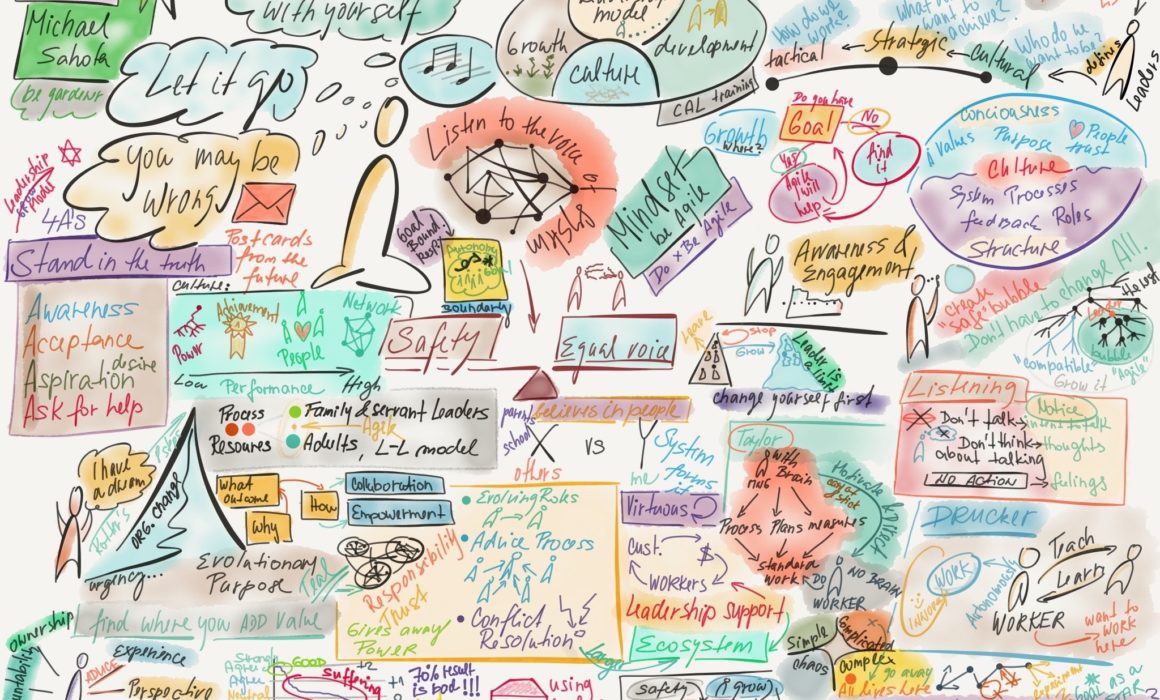
I was extremely privileged to share a day with Pascal Pinck and learn his “playbook” as a powerful influencer. His lessons span mental models, coaching stance and tools for effecting change.

The infographic above expresses the key concepts – I will tie them together below.

Situational Awareness (Stance)

The place to start as an influencer is as a “co-sufferer”: to approach a system with deep respect and humility. Siraj Sirajuddin refers to this as “supplication”. I have experienced that this is the single most critical ingredient for success. More on this in coming posts.

When connecting with a system is essential to “Listen to the music, not the words” (Quote from Gerry Weinberg). This is because language may transmit conflicted sentiments and channel residue from past traumas, whereas the underlying spirit knows what is needed to create a resonant future.

One expression of respect for a system is detachment from the outcome – accepting the will of a system to choose it’s own destiny.  Pascal says this has gotten much easier for him since he accepted the reality that systems will not generally let influencers move them in a direction that is counter to their underlying orientation or DNA anyway.

Think of the organization as a person

An organization is a biological, organic system. We can use the metaphor of a human body as way to think about making interventions. We may also think of a system as having a personality: what are it’s hopes, fears, dreams and ambitions? See KrisMap for a workshop to explore this.

Homeostasis in the human body is a very powerful force that keeps us healthy. In systems, the status quo is expressed through the invisible and powerful force of organizational culture. It’s like the water we are swimming in that we can’t see. What can draw us away from homeostasis?

Compelling Shared Vision is a Critical Attractor

A shared vision is not enough. It needs to be a compelling shared vision to create a strong enough attractor to shift away from the status quo. Values and purpose intertwine with the vision to create a powerful attractor. A particularly powerful vision is that of a breakthrough organizational culture.

One purpose of compelling shared vision is to help induce relational flow so that the parts of the system are constantly aligning and self-synchronizing, which allow multiple sources of energy to pull in the same direction.

Intervene with Leading Indicators

One problem with organizations that focus (at a strategic level) on goals is that outcomes are by definition lagging indicators. Influencers get better results by focusing on the leading indicators. A simple example of this is whether to focus on team trust, alignment, and communication patterns (leading indicators) or budget variance, “lessons learned” and “best practices” (lagging indicators).

Pascal uses the metaphor of acupuncture where you poke the body in one place to get a result in another. For this to work we actually have to have some sort of model of the connections between things. In line with Cynefin framework for complex environments we can’t fully understand situations but can conceptualize “probabilistic directionality” to reason about interventions.

Oscillate between future and current state

A good influencer will oscillate between current state and future state. We need to connect with the current state to have empathy for the system and we need to connect with the future state to provide direction and sense mismatches. It also provides a great source of questions.  Pascal recommends The Three Laws of Performance by Logan and Zaffron as an excellent way to develop a deeper understanding of this topic

Acknowledgements

I would like to thank Pascal for inviting me to LA last year to experience one of the most insightful days of my life and for sharing the secrets of his success. And then for co-writing this post with me.

I would like to thank Siraj Sirajuddin who developed or co-developed several of the ideas expressed in this post.

Comments (1)

Change your Culture or Die

Great Organizational Culture is Key to Thriving

Deming said that “Survival is Optional”. Organizations can change their mindset and culture or they can become extinct.

Companies are at Risk

Steven Denning  makes a great case for why companies are at risk: Only 21% of employees are fully engaged, Customers are dis-satisfied and bureaucracy is killing innovation. “Deloitte’s Shift Index shows, the average life expectancy of a Fortune 500 company has declined from around 75 years half a century ago to less than 15 years today, and heading towards 5 years if nothing is done.”

We can see new companies creating opportunity by using organizational culture as the competitive advantage. Some examples are: Zappos, Morningstar, Valve.

Choose your Level of Risk

The graph above shows that the risk of extinction for an organization depends on the rate or ability of the organization to change. As discussed about, traditional corporate culture poses a high level of risk as it only tolerates a low rate of change. Organizations that use culture as a competitive advance have a lower risk of extinction. The two lines show that different organizations have differing risk profiles based on industry and markets they are involved in.

We can think of a fitness landscape of organizations: some are very robust to environmental changes and others are brittle. The top reason to change the culture of your organization is not because of this quarter, this financial year, but to create a lasting future and avoid the extinction event that is perhaps a few years out. Sadly, few companies invest time into thinking about how can we be great and how can we go out of business – the status quo is a powerful attractor.

What Culture?

OK, let’s say I want to change my culture. Now what?

There are a number of related and complementary approaches. Stephen Denning argue that the single organizational focus needs to be Customer Delight. Senge advocates the need for a Learning Organization. The Agile mindset is about people with a shared vision collaborating and learning together. A key misunderstood value from Lean is Respect for People. There are also recent movements and ideas converging on what thriving organizations look like: Stoos NetworkWorldBlu and Future of Work Manifesto.

What is best? Many are good and share common characteristics. My current investigation is to clarify and refine cultural differences between various approaches. The most important thing to remember is that: Perfection is a direction and not a target. Use KrisMap or another approach to define your ideal culture and then pursue it.

Acknowledgements

This post is inspired by conversations and a session with Saleem Saddiqui at Agile Coach Camp in Minneapolis earlier this month. It was Saleem who shared the quote “Survival is Optional” to start a great conversation. Key ideas in this post are Saleem’s – not sure what he shared and what I imagined.

Comments (1)

Culture Profile: Hacker & Open-Source

At CultureCon in Philadelphia I had the opportunity to interview Eric Raymond about hacker and open-source culture.  Eric is a spokesperson for a rather amorphous community and is well-known for books such as The Cathedral and the Bazaar and more recently The New Hackers Dictionary.

Eric sees a union of hacker and open-source culture so that these have become essentially the same thing. I’ll just call it hacker culture…

Eric shared that hacker culture is ancestral to Agile as the manifesto was there in folk practices but not explicit. Eric was invited to the Snowbird conference where Agile was defined but missed it.

The most important point that Eric wanted to share is that hacker culture is expressed through language, jokes and common stories about history. For more reading on hacker culture, please see Eric Raymond’s FAQ on hacker culture and history.

The interview question is based on the KrisMap workshop and is brilliantly simple:

If you expressed the culture of a typical hacker organization as a person, what would she be like?

Hacker Persona is playful, purposeful and self-managed

Eric described the following attributes for the hacker persona:

  • Intense focussed playfulness (Neoteny)
  • Distrust of Authority
  • Self-managed
  • Rage against the machine
  • Sense of mission/purpose
  • Introverted
  • Shadow autist/Asperger’s syndrome
  • Hates being lied to

Observations

I can see from Eric’s persona how this would sew the seeds of Agile culture. The part of Agile culture that would be a stretch would be introversion and Asperger’s which are not well supported in the team environment that Agile promotes.

Acknowledgements

I would like to thank Eric for taking the time to share his thoughts and Olaf Lewitz for the wonderful photo.


Leave a Comment

Culture Profile: Core Protocols

As part of my investigation of high-performance organizational culture, I share the results of an interview with Vickie Gray who has been training people in the Core Protocols for 10 years. “The Core Protocols are our “best practices” for people, teams of people and organizations that want to get great results – all the time.” – Jim McCarthy.

The interview question is based on the KrisMap workshop and is brilliantly simple:

If you expressed the culture of a typical booted (adhering to Core Protocols) organization as a person, what would she be like?

It could be anyone – Core Protocols requires diversity

Vickie’s first response to the  what a booted organization’s persona is like is that “It could be anyone.” It’s about the best idea and delivering greatness on time. And this requires diversity in culture.

This response is of particular significance – the Core Protocols would appear to be on the surface culture agnostic, since it is a set of rules. See below for further discussion.

Booted (Core Protocols) Persona: Michelle is results-oriented, coherent, and asks for help

With some additional prompting Vickie ran a “film roll of all the booted people I know”. The result is Michelle:

  • Knows what she wants
  • Not afraid to tell people what she wants
  • Results-oriented
  • Coherent in Thought, Word, Action
  • Has Fun
  • Integrating Beauty and rationality. e.g. Music and Philosophy
  • Seeks out help from anyone without knowing the help she will get

Some Observations

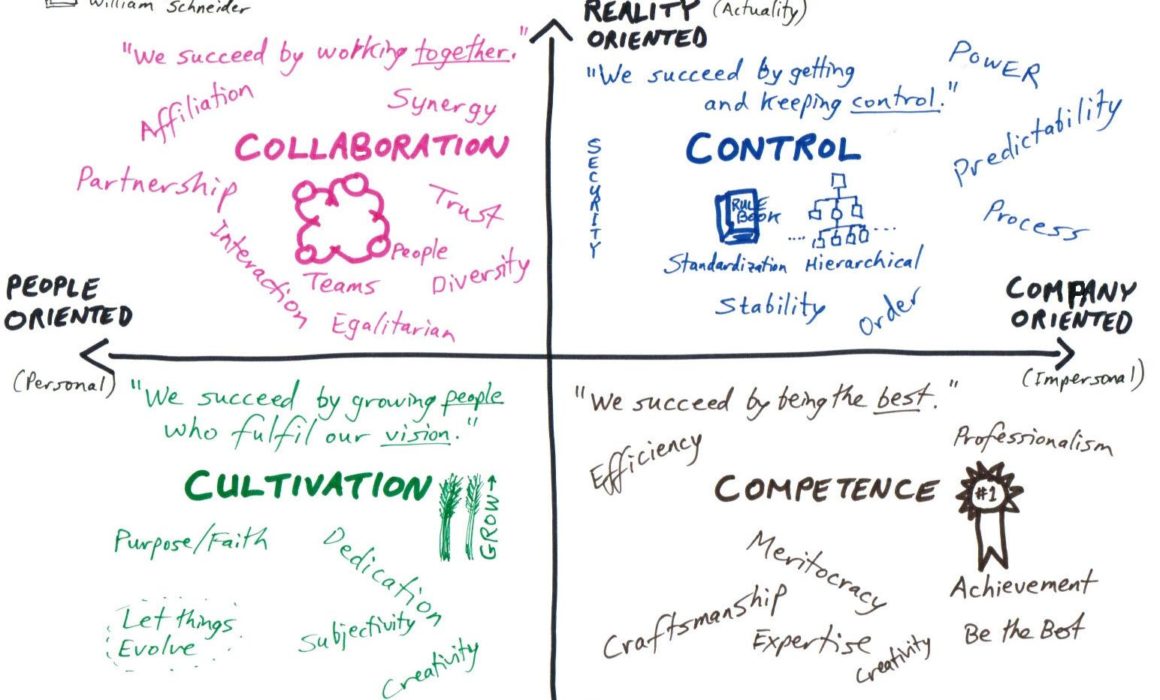
On reflection, I do not think that the Core Protocols is neutral in terms of Culture. Themes like greatness, personal competence and strong focus on results is suggest a focus on Competence Culture (in context of Schneider culture model).

One example of how it differs from Agile is that Agile promotes collaboration

Acknowledgements

I would like to thank Vickie Gray for playing with me in answering such a strange question at CultureCon Philadelphia.

I would like to thanks Olaf Lewitz for co-creating the KrisMap Persona workshop.

P.S. Check out Vickie’s new book – Closing the me-you gap.

Leave a Comment

Culture Profile: WorldBlu & Freedom at Work

As part of my investigation of high-performance organizational culture, I share the results of an interview with Traci Fenton from WorldBlu . Her motto is “Freedom at Work”. I have been an individual member for a few months since I believe WorldBlu is largely aligned with what I have seen work in the Agile space for building high-performance culture.

WorldBlu Persona: Sky is Centered and Balanced

The interview question is based on the KrisMap workshop and is brilliantly simple:

If you expressed the culture of a typical WorldBlu member organization as a person, what would she be like?

Traci describes what she sees in a “freedom-centered company” named Sky:

  • Strong sense of self-worth
  • Strong sense of self-trust
  • Deeply interested in other people
  • Authentic
  • Aware of fears, but not limited
  • Spiritually minded
  • Global perspective
  • Understands the oneness (interconnectedness) of life
  • Major butt kicker (in a good way); she’s got grit
  • Gentle, but powerful
  • Patient, but never satisfied
  • Calm, but passionate
  • Core of what motivates her is love

Some Observations

I notice there are some commonalities and differences with Agile profiles. I share this as a way of sensing energy and direction, not as a binary statement of what is or is not included in the cultural perspectives. Further, I make these observations as sense-making and not out of seeking a “best”. All perspectives add value.

In common, I see:

  • Values other people
  • Values self
  • Focussed
  • Purposeful

Greater emphasis in WorldBlu persona:

  • Global perspective
  • Connection between work and life

Greater emphasis in Agile:

  • Curious
  • Learning

Acknowledgements

I would like to thank Traci Fenton for taking the time to speak with me at CultureCon Philadelphia and share her perspective of WorldBlu.

I would like to thanks Olaf Lewitz for co-creating the KrisMap Persona workshop.


Leave a Comment

KrisMap: An Organisation’s Persona

(Joint post with Olaf Lewitz)

Essence of Kris

Imagine your ideal organization.
We may think of the organizational culture as the “personality” of the company.
What is the personality of this organization?

Culture is Aggregate Identity

Organizational Culture is the emergent aggregate identity of all her people.

Some questions to help you think about Her Persona:

  • What is the organization like?
  • What does she like?
  • What does she want?
  • What does she feel?
  • What does she look like?
  • How does she behave?


Kris (Agile Persona) is purposeful, curious and values people

  • Values People: listens well, is caring and loyal
  • Curious, Open and Playful
  • Resilient and Flexible
  • Relaxed, Happy
  • Purposeful and motivated

See below photo for our very first Agile persona – Kris.


How to run the KrisMap Workshop

  • Briefly explain concept of culture and personas.
  • In small groups, brainstorm key personality attributes of persona. (Remember to name her).
  • After cluster, select key or salient features.
  • (Do not prioritise, everything might be essential. Encourage to write more attributes and add them if no one objects.)
  • Share with large group. (Keep adding attributes as people get more inspired.)

Debrief

  • Would you want to work with Kris?
  • Would you want to hire Kris?
  • Is Kris attractive to customers?
  • Do you find any attribute of Kris that cannot be learned?
  • (if an attribute is identified as being hard to achieve, ask if it might be easier if you have a team to help you)
  • Is it your organization’s goal to be like Kris?
  • Do you aspire to be like Kris?
  • What examples for Kris’ attributes do you find in your current org? Share stories.

Our Key Observations/Learnings

  • Kris is an aspirational model — no one can actually be Kris.
  • Everyone can learn. Some attributes are easier than others. Teams help. Coaching helps.
  • Diversity in the team/organization allows Kris to emerge. Not every member of an organisation needs to (or should) have all of the map’s attributes…
  • Transformation of an organization occurs through the transformation of individuals.
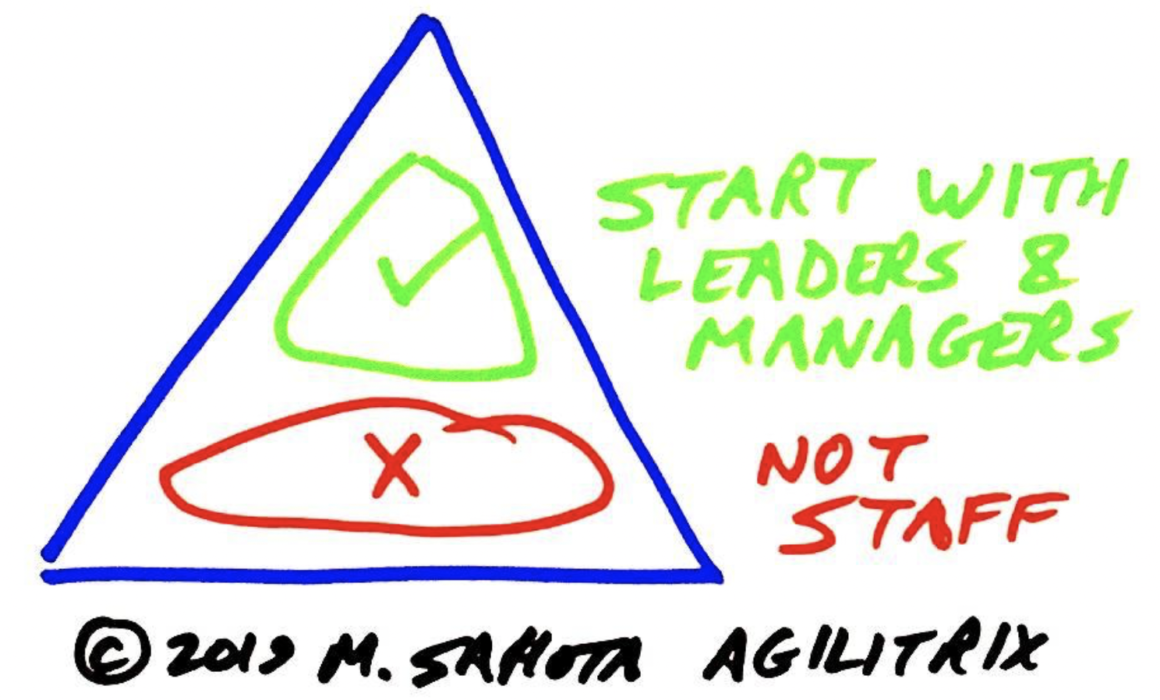
  • Transformation needs to start with the leadership team.

Laura is energetic, caring and effective

Mona is purposeful, pragmatic and always learning

How To Use This

Do this exercise with your leadership team, frame the question as “How would you love your organisation to be?”

No organisation can grow, transform or flourish faster than their leadership team and, ultimately, their CEO (given you have a hierarchical structure).

We found in five sessions that all participants agreed that all their wanted attributes can be learned. They all agreed that this learning will be easier and faster in a team. They all ultimately wanted to be that persona that they had created, they identified it as an aspirational model to strive for. A personal vision they can align with and focus on.

To ground the group (which might feel like they entered a dream state of mind during the exercise and ask puzzled questions like “how do we start to make that happen?” ask them for one more step:

Try to remember stories that happened in this very organisation where someone has shown some attempt at the behaviour you now wish you’d see. Find examples of learning, pragmatism, experiments, care, unusual effectiveness, appreciation… (use your own persona’s attributes, of course.) Let them see for themselves that the behaviour they want is already possible in the current state of the organisation, is already present in its DNA.
A Want is a baby Have…
(Michele & Jim McCarthy in Software for your Head)

Acknowledgements

There is no Organization!” by Ari-Pekka Skarp got Olaf started to rethink his concept of organisation. Bob Marshall pushed him further in “There is no Organization, but…” which in the comments discussion inspired the idea of collaboratively creating an organisation’s persona.

At the Agile Influencers of DC meetup Michael and Olaf ran an experiment out of which this session design emerged with the help of Paul Boos, Andrea Chiou, Ken Furlong and Tucker Croft.

We re-ran the exercise at CultureCon in Philadelphia and AgileCoachCamp in Minneapolis (Laura & Mona), with great feedback (“May I use this?”) and at a first client. Thank you to all who created the context for us to emerge this.

And, yes, you may use this. Please tell us of your results.

Comments (3)

Beyond the Maelstrom: Chaotic Behaviour is matter of Perspective

I created the painting below almost two years ago to reflect the pain, frustration and disconnection I felt as an Agile consultant when working with a large organization.

At the time I thought of Agile as a coherent system of energy – waves of light – illustrated by the yellow lines in the top left.

Along with other coaches, we thought the organization was chaotic or complex as defined by the Cynefin framework. The organization is illustrated by blue structure. The severe difficulty we had working with it is expressed as a swirling mess of green.

In hindsight it is clear to me that the mess of interactions was the result of the incompatible culture and thought systems between the coaches and the client organization.

I suspect the client may have had the opposite perception: that they had a coherent and understandable structure while we Agile coaches seemed chaotic.

Future success relies on understanding these differences in perspective due to culture and other dimensions.

To help others avoid pain and waste, I wrote An Agile Adoption and Transformation Survival Guide: Working with Organizational Culture Consider reading it to learn from my failures and to avoid creating your own.

This painting was one of the candidates for the cover art.

Leave a Comment

Visual Summary of Agile Adoption and Transformation Survival Guide

After providing my 13th verbal summary of my session at Agile 2012, I realized that I did not have an infographic summarizing the session and book – An Agile Adoption and Transformation Survival Guide. So here they are.

Agile Failure & Culture

Agile Differs from Most Company Cultures


Adoption –> Doing Agile; Transformation –>Being Agile

Agile Adoption <—->  Transformation

There are a range of approaches – some are more appropriate for adoption vs. transformation.


Leave a Comment

Agile Failure and Culture – Agile 2012 Workshop Results

What follows are the workshop results from Agile 2012 Session “An Agile Adoption and Transformation Survival Guide”. Book, slides, and video explaining the session.

The results are based on 120 people in the interactive section (there were another 60+ observers I was unable to involve).

Confirmed Insights

  1. Failure rates are high. Success reports are 2.8 average out of 5.
  2. Control culture is dominant in the majority of companies.
  3. Agile culture is primarily about collaboration culture. Cultivation and Competence cultures and are secondary.
  4. Lot’s of companies are “doing Agile” practices, and not “being Agile” (mindset)

Agile Failure rates are high

As can be seen from the photo on the right, people have reported different levels of success with Agile. 5 means always successful and 0 means never successful. The average of the respondents is 2.8 out of 5. This is a success rate of a little less than 60%. Ouch!

Reasons for Agile Failure

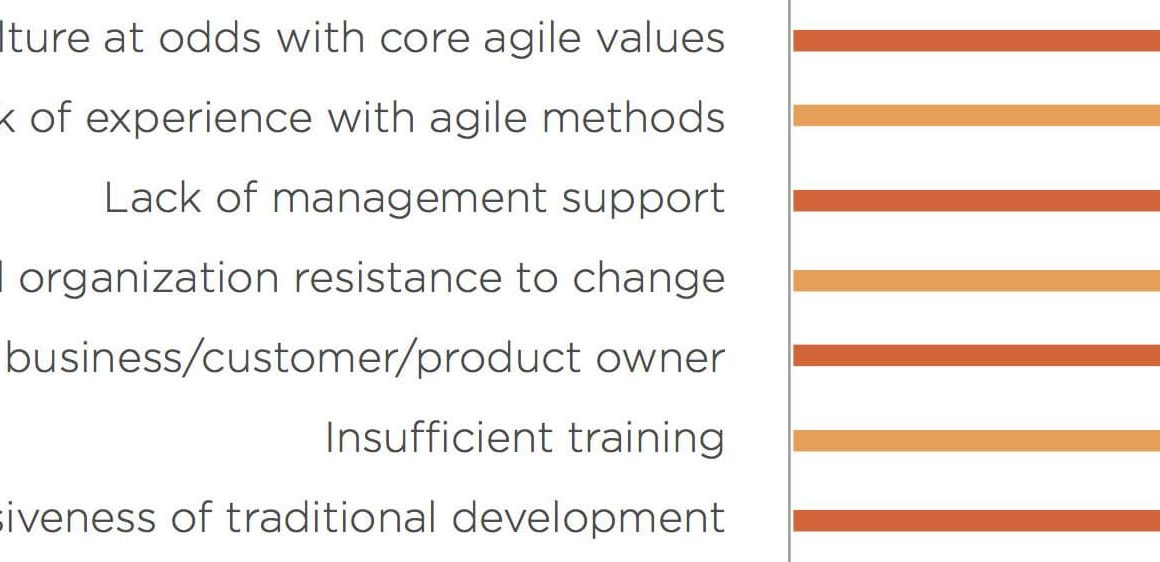
The photo below shows the reasons participants encountered Agile Failure. Notice that the most common item mentioned was management understanding and support.

Control culture is dominant in the majority of companies

As we can see here, approximately 77 out of 108 participants indicated that their dominant organizational culture is Control using the Schneider model. This is a little higher than 70%. And this is at an Agile conference!

Agile is about Collaboration culture

In the workshop, participants were asked to associate Agile values and principles with the cultures of the Schneider culture model. All twelve tables agreed that the dominant culture expressed by Agile is about Collaboration.

But what of Agile’s secondary culture? Three groups identified Cultivation culture while nine groups identified Competence culture. On the surface, this would seem to invalidate my claim that Agile is about People (Collaboration and Cultivation). My understanding of this is that on the surface, terms like “working software” are interpreted as signs of Competence culture whereas “working software” is a goal that can be satisfied by any cultural approach. My conclusion is that this exercise needs more time and discussion than I allocated to avoid simply sticking principles into the closest fit culture quadrant.

Either way, we can see that there is a big gap between Agile culture and current organizational culture. This is the aha moment that causes people despair.

Below are two examples. On the left there is the association with Competence and on the right, a balance of Cultivation and Competence. Click on images to see details of values and principles identified.

Doing vs. Being Agile

Another interesting artifact to share is what participants thought were the salient differences between “Doing Agile” and “Being Agile”. See photo below. This list is the result of large group shout-out/brainstorm so consider it directional rather than a crisp definition.

Approaches to Adoption/Transformation

At the end of the session, some participants share adoption and transformation techniques that I did not include in my slides or book. These are a mix of approaches and models. Interestingly, each one also has a book.

Want More?

Please see Book, slides, and video explaining the session.

Leave a Comment

Book – An Agile Adoption and Transformation Survival Guide: Working with Organizational Culture

I am very excited that I just published my free book - An Agile Adoption and Transformation Survival Guide: Working with Organizational Culture on InfoQ. Agile change agents will find it valuable in helping companies succeed with Agile and avoiding failure.

About the Book

Struggling with Agile? Frustrated that people don’t really get it? Tired of fighting with organizational bureaucracy? Wondering how you could have been more successful? If so, then this book is for you!

The book provides a set of essential thinking tools for understanding Agile adoption and transformation: how they differ and what you need to know to know to avoid being another statistic in the widespread adoption failure. In particular, you will learn how to use culture to work more effectively with your organization.

It is called a survival guide since so many people have found the concepts to be invaluable in understanding their experiences when working with Agile.

This book includes:

  • Identification of causes of the widespread Agile adoption failure
  • A model for understanding Agile, Kanban, and Software Craftsmanship culture
  • An outline of key adoption and transformation approaches
  • A framework to help guide when to use these these approaches with your organization
  • Real-life case studies of what has worked and what hasn’t

Electronic Version is Free

You can get a PDF or ePub version of the book for free on InfoQ. Why free? My primary goal is to change the world of work, and by making it free I can best achieve this goal. Of course, I would be really happy if you bought multiple copies of the print edition to give to your friends and clients to help them succeed as well as support my work.

Thank You

“If I have seen further, it is by standing on the shoulders of giants.” – Isaac Newton

I would like to thank Henrik Kniberg who has contributed so much open source material to the Agile community and inspired me to write a free eBook to pay it forward. I also appreciate him taking the time to write one of the forewords.

I would like to thank the attendees of workshops with early incarnations of this material – XPToronto, SoCal Lean Kanban, Agile Tour Toronto, and Agile New England. Your comments, challenges and reflections have helped in immeasurable ways.

Thanks to all the people who read my blog posts throughout 2011 on this topic and provided valuable feedback.

A big thanks to Michael Spayd for first introducing me to the Schneider culture model and for conducting a survey of Agilistas.

For sure this work would not exist but for Mike Cottemeyer’s differentiation of adoption and transformation.

Thank you to the review team for feedback: Chris Williams, Irene Kuhn, Armond Mehrabian, Krishan Mathis, Bernie Jansen, Ed Willis, Eric Willeke, Karl Scotland, Sabine Canditt, Todd Charron, Bob Sarni. Olaf Lewitz in particular deserves distinction by providing an extraordinary quantity of valuable comments, questions and challenges.

I would like to thank those who directly contributed to this work as well as reviewing: Olivier Gourment for contributing a case study; Jeff Anderson, Olaf Lewitz, Jon Stahl, and Karl Scotland and Alexei Zheglov for sharing their challenges and alternate visions in the appendix.

I would also like to thank Alistair McKinnell, Jason Little, Declan Whelan for providing feedback on the Methods & Tools article that formed a chapter in this book and to John McFadyen and Dave Snowden for feedback on the Cynefin section.

I am very appreciative of Jurgen Appelo for taking time out of his busy schedule to write a foreword.

And of course a big shout out for my daughter Scarlett who provided original art with the jigsaw puzzle and butterfly transformation drawings.

Wow! Even a small book such as this benefits from so much help.

- Michael Sahota


Comments (5)