How to Make Your Culture Work (Schneider)
(This post is part 1 of Agile Culture Series – see Reading Guide for more).
I finally had time to read The Reengineering Alternative: A plan for making your current culture work by William Schneider. If you are at all concerned about successful Agile adoption, then this is a must-read.
Before reading the book, I already had a pretty good idea about it thanks to a private seminar with Michael Spayd and a conference session by Israel Gat – How we do things around here in order to succeed. But when reading the book, I crystallized my thinking about a whole number of disparate experiences and open questions.
In this post, I will cover the key concepts of the book. Analysis and connections to Agile will follow in subsequent posts.
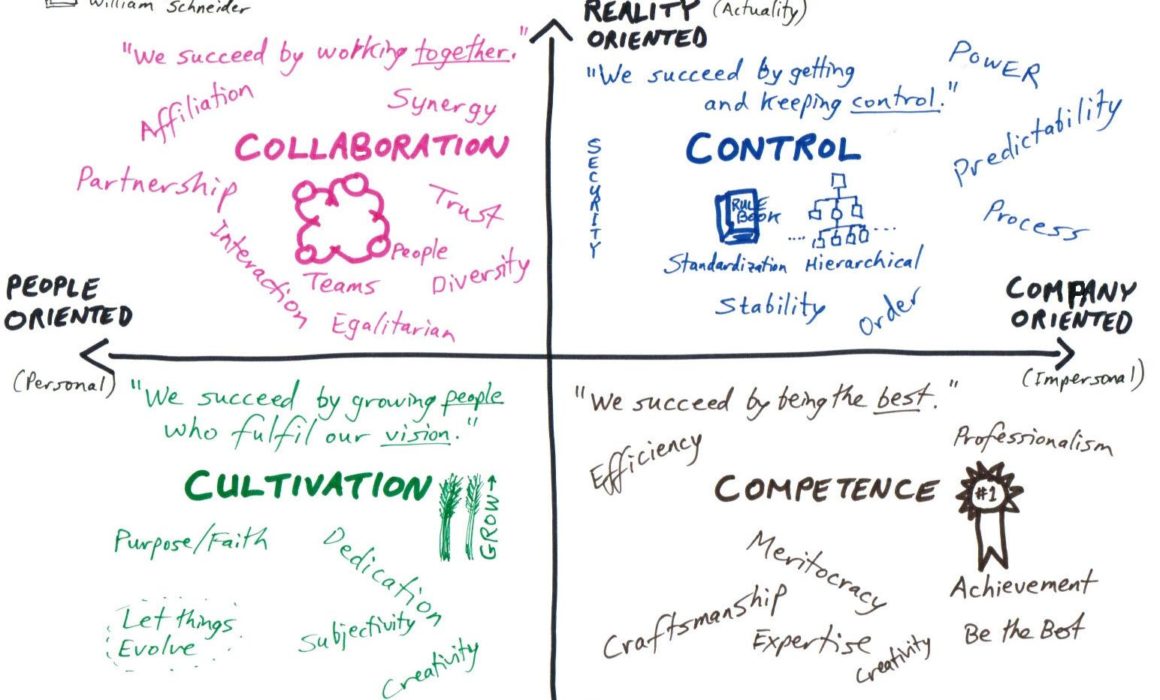
Schneider Culture Model
In the diagram below, there are four cultures depicted – one in each quadrant. Each has a NAME, a “short quote”, a picture, and some words the characterize that quadrant. As you read through this, you may will get a sense of where your company is.
There are also two axis that indicate where the focus or an organization is:
- Horizontal: People Oriented (Personal) vs. Company Oriented (Impersonal)
- Vertical: Reality Oriented (Actuality) vs. Possibility Oriented
This provides an a way to see relationships between the cultures. For example, Control culture is more compatible with Collaboration or Competence cultures than with Cultivation culture.
Key points about culture
- Management guru Peter Drucker says “Culture … is singularly persistent … In fact, changing behaviour works only if it is based on the existing ‘culture’”
- No one culture type is better than another. The book details the strengths and weaknesses of each so check it out if you are curious to learn more.
- Depending on the type of work, one type of culture may be a better fit.
- Companies typically have a dominant culture with aspects from other cultures. This is fine as long as those aspects serve the dominant culture.
- Different departments or groups may have different cultures. (e.g. development vs. operations)
- Differences can lead to conflict.
How to make Culture work
The starting point for making culture work is understanding it. The book describes a survey you can give to staff (Example Survey from Book in Survey Monkey – N.B. You can’t see the results). The book suggests using this as a starting point for culture workshops with a diverse group of staff.
There are several suggestions for using cultural information to guide decision-making:
- Evaluate key problems in the context of culture. Sometimes changes are needed to bring the culture into alignment with the core culture.
- Sometimes the culture is too extreme (e.g. too much cultivation without any controls – or vice versa!), and elements from other cultures are needed to bring it back into balance.
- Consider the possibility of creating creating interfaces/adapters/facades to support mismatches between departments or groups.
Well, that’s the book in a nutshell. More to follow on how this relates to Agile.