Archive for Games and Simulations

Agile Games 2012 Keynote – Games Landscape and Importance of Play

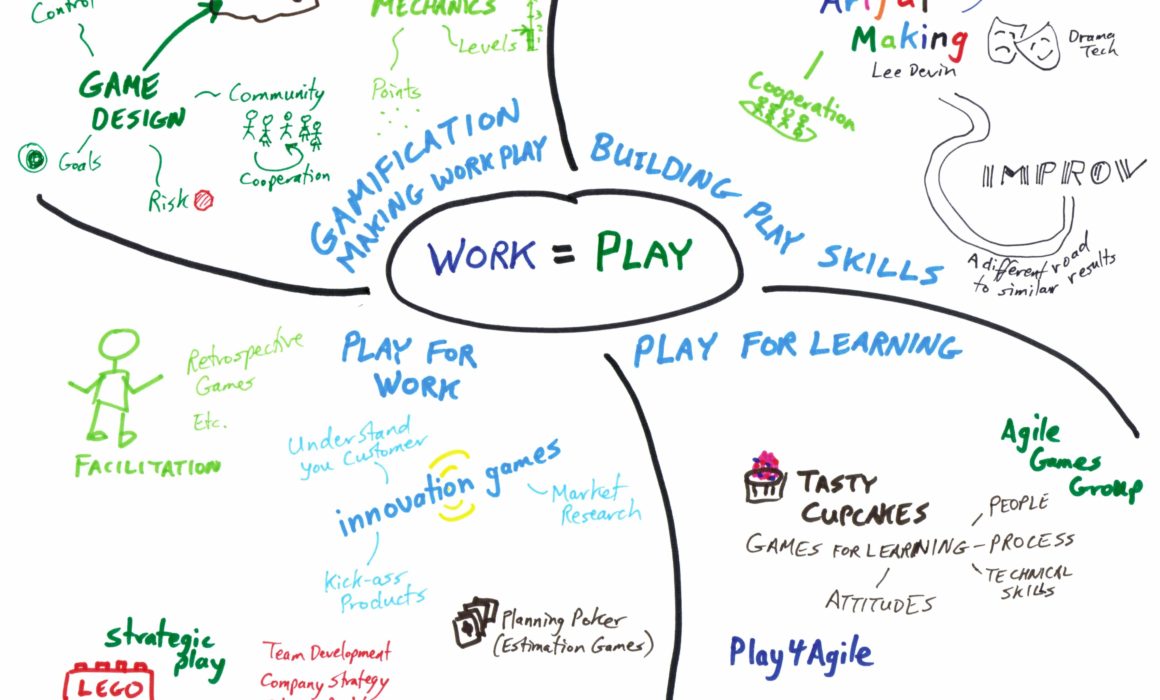
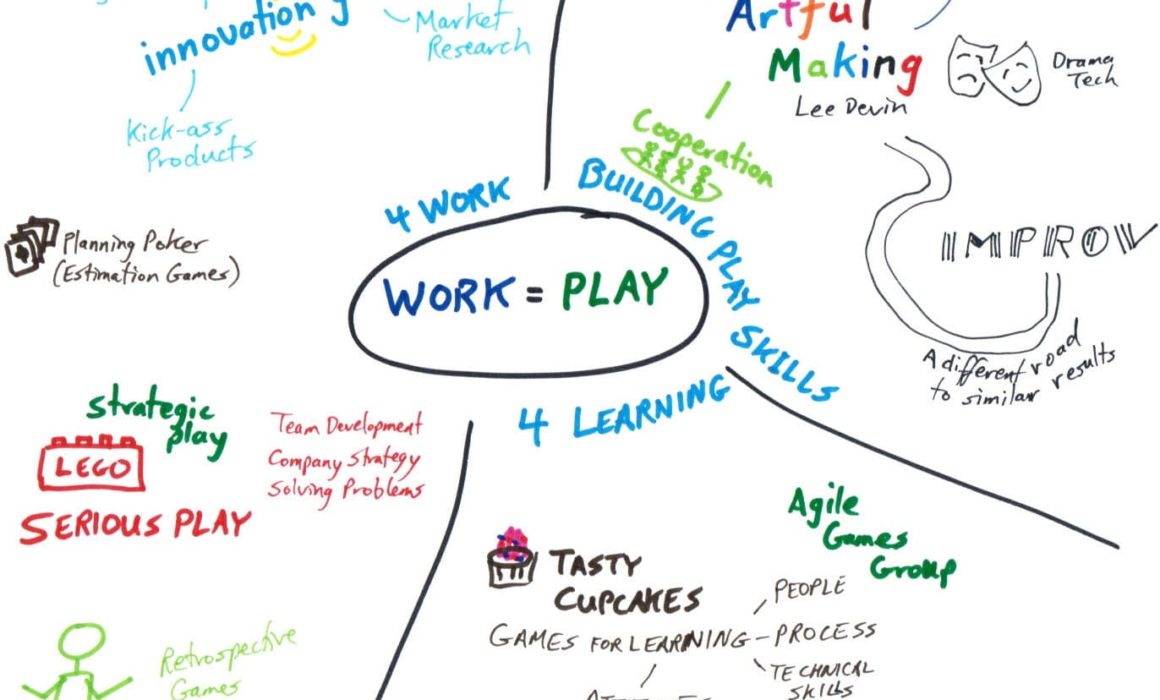
Here is my Games Landscape Infographic and slides from my Agile Games 2012 keynote presentation.

Overview

Play is a powerful tool for achieving business results. A common question is, how can I do this in my current work environment? The purpose of this talk is to orient you to a variety of different ways that you can introduce play to solve real-world problems. Whether you are a leader, coach, and even individual contributor, there are ways to amplify the workplace with play.

Welcome to a guided tour of the play landscape. This guided tour will help you navigate the different techniques with the space of games and play in order to see how they can help you. We will start our journey with ways to harness the power of play through games to do valuable work. Next stop is about using games for accelerated, deep learning. At the peak of the tour we visit the ways we can develop our play skills. The final stop on our tour is how to embedded play into our work contexts.

At the end of the tour you will have a map for exploring play and perhaps even a burning curiousity about some newly discovered places.

Play and Games landscape

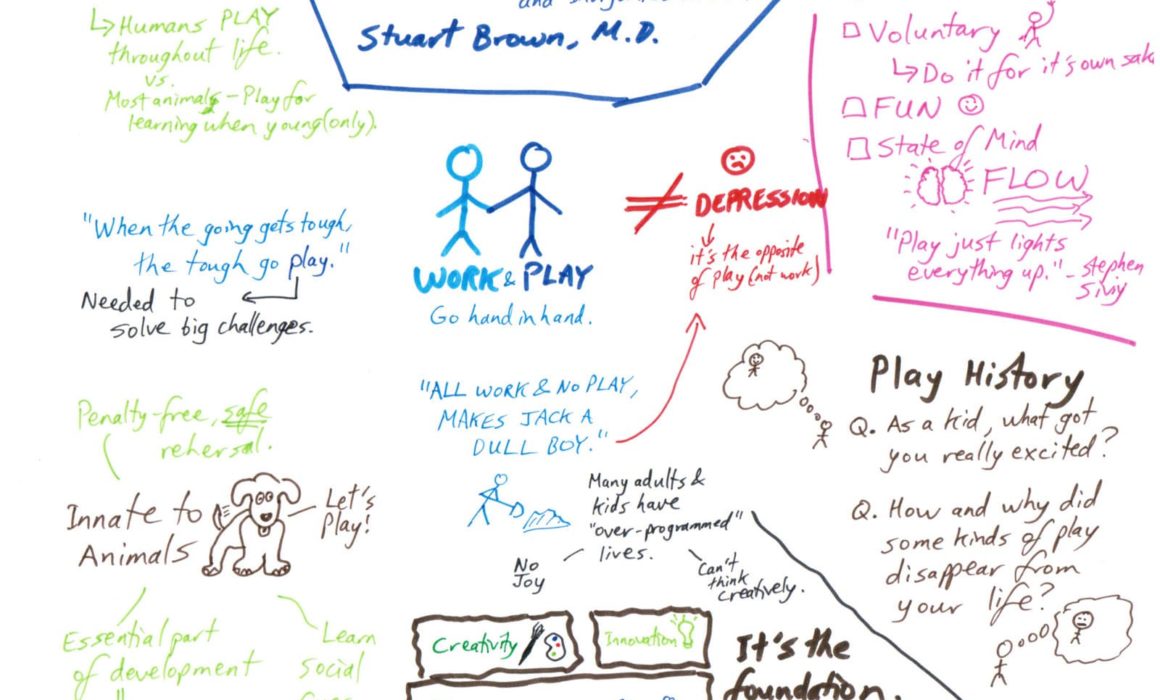
For the infographic on Stuart Brown’s book on Play, please refer to The Science of Play.

Presentation Slides

Leave a Comment

Epic Games FTW via Jane McGonigal

Play is essential for innovation and high-performance teams. And games can help us get there.

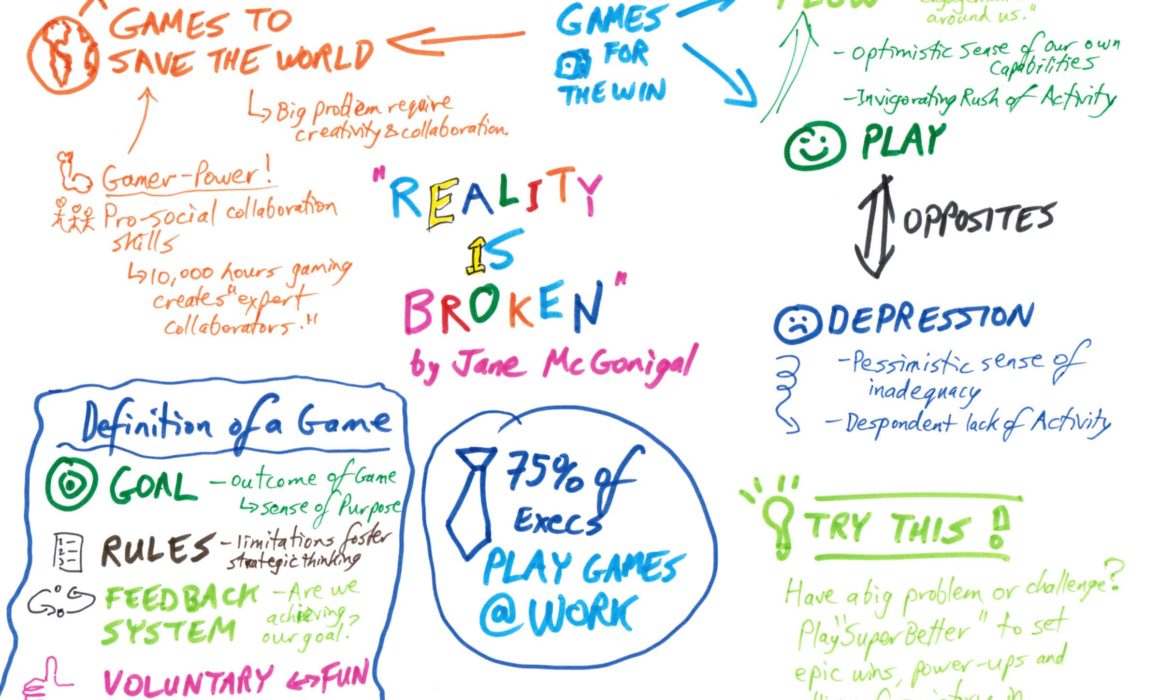
Jane McGonigal has written a fabulous book, “Reality is Broken: Why games make us better and how they can change the world.” In it she explores large-scale online games that are part of the commercial video game industry as well as ones about producing direct real-world benefits.

As is my usual want, I prepared the visual note below to capture the most important aspects of the book to me.

Jane defines a games as having four important characteristics: a goal, rules, a feedback system (so people know whether they are reaching their goals) and voluntary participation. I found the last characteristic very interesting. With Agile and Scrum in particular we promote self-organizing teams where people sign up for work rather than having it assigned. In fact, many facets of Agile make work more like play. The principle of voluntary participation also aligns with good management practices such as “treat everyone like a volunteer”.

I really like how play and being in a state of flow is differentiated from it’s opposite: depression. I just love the definition of play and flow as an “intense, optimistic engagement with the world around us.”

Jane paints a compelling picture of the capabilities and talents of video game players. She states that young adults will have had the 10,000 hours or practice needed to become experts at pro-social collaboration skills through playing video games. Gamers with this level of skill – a superpower – can collectively accomplish great things.

I used to think games were the cat’s meow, but now I see them as just one way to help people reach a state of flow through play (see: Three Ways to Use Play for Business Results). For me (at work), games are a means to an end. At home, one goal is having fun; another is bonding with the people I play with.

The most fun fact I found in the book was: “75% of executives play games at work”. Usually to take a break and relieve stress.

But the BEST of all was learning about and playing SuperBetter to up my game in dealing with some challenges in my personal life. If you are struggling with anything, perhaps you might like to play this game for the win.

If you haven’t already seen Jane’s TED talk – Gaming can make a better world – I highly recommend it.

Leave a Comment

Agile 2011 Preview – Innovation Games and Strategic Play with Lego

I am heading off to Agile 2011 and I wanted to share why I am really excited to be attending.  It’s really all about the power of play.

Understanding Flow through Games

I was fortunate to be accepted to the Agile Bootcamp track to present Lean Fundementals: Understanding Flow through games. I am thrilled since this touches on two passions of mine – Lean/Flow thinking and using games for learning.

Strategic Play® with Lego® for Solving Serious Problems

I am going to run two open jam sessions (each with a maximum of 14 participants) to use  Strategic Play® with Lego®  to solve some serious problems or build a shared vision. I will announce the times via twitter (follow-me) and also using the open jam board.

One of these will be focussed on generating leadership ideas for the Scrum Alliance. Some example acceptance tests for leadership are:

  • There is a clear compelling vision of the Scrum Alliance that is supported by 70% of the membership.
  • Satisfaction with leadership in Scrum Alliance is high. (e..g more than 4 out of 5 on survey).
  • Public perception of the Scrum Alliance is positive.
  • Members feel like their voice is heard regarding key decisions.


Innovation Games® T-Shirt Contest

You probably already know that Innovation Games® are amazingly powerful for supporting Product Owner/Manager communication and discovery with customers and stakeholders.

What you may not know is that there is a game at Agile 2011 for promoting awareness about Innovation Games® using a photo contest. Get your picture with me and other trained facilitators to win cold hard cash. I am very excited to participate and am bringing my two t-shirts. See front and back below. Sadly, my new tshirt did not get here in time…

Tasty Cupcakes – Game on!

I have been working with Mike McCollough and Don McGreal to accelerate tastycupcakes.org as the destination site to find and share games for learning about Agile and for games that do valuable work.

Games provide a way for people to play to get outstanding business results or accelerated learning.  Spot me wearing a TastyCupcakes tshirt and I’ll help you find the game for you!

Coach’s Corner

As a Certified Scrum Coach I thought I would pay it forward by participating in the Coach’s Corner to help coaches.

If you were thinking that this is not about play or games, well either you are right or life itself is a game. A collaborative one.

My office hours are:

  • Monday 8am-9am
  • Thursday 5pm to 7pm
  • Friday 8am-9am


Leave a Comment

Three Ways to Use Play for Business Results

Play is a profoundly powerful tool for achieving business results. I think of three main ways to accomplish this: Using explicit play to do work, using play for learning, and building people’s play muscles.

Consider the following diagram:

Play for Work

The goal is here is to take difficult, boring, unproductive work  and create great results through play. In the diagram, I give a few examples of how to make work through play:

  • Innovation Games® have a proven track record of using play to help companies understand their customers and build innovative products.
  • Planning Poker is a well-established team based estimation technique that is now complemented by other estimation games.
  • Lego® Strategic Play® is a hands-on activity for solving tough problems, team development and creating company strategy.
  • The world of facilitation provides a host of engaging activities from team retrospectives to Open Space.

For more information, check out some ways I help clients with bring play to work.

Play for Learning

I have been very involved in games to assist people learning about Agile, Lean, etc. I made a helpful diagram that shows different types of games and what they can be used for. Probably the best place to go to find a game is TastyCupcakes.org – it’s a community-driven and has an ever-growing collection of games. I even volunteer my time to make it better for everyone – that’s how much I care and believe in play as a powerful dynamic.

Of course, play goes well beyond Agile through folks such as training master Thiagi and GameStorming. (Both are on my to-learn list)

Building Play Skills

What if you want to build the skills of your team or organization to harness play as part of daily work? To have play and creativity permeate everyone and everything? For this, your best bet comes from dramatic techniques such as ArtfulMaking and DramaTech. Also, strongly recommended are Improv skills. You may notice that these are not just about creativity, they are also about listening and collaboration as an added bonus.

For results, play on!

Leave a Comment

Coaching Skills Dojo

Although Agile coaching requires many skills, we get back to basics by revisiting three fundamental coaching skills: observing, listening and questioning.

As you put these three key skills into practice, you will get feedback on your performance and have the opportunity to try out improvement ideas in a safe, open and friendly environment.

Learning Objectives

  • Practice listening without judgment
  • Gather information more effectively
  • Ask different kinds of questions to understand the real problem
  • Gain fresh insights into a problem you face at work

Recipe

  • Number of participants: 6 to 20 (could go to 30 with a bit of deterioration)
  • Team size: work in groups of 3.
  • Duration: 90 minutes (can be made shorter or longer)
  • Materials: Flip chart paper and marker for each group.
  • Setup: Chairs for sitting, walls for flipchart paper.
  • Credits: This game was created by Michael Sahota and Portia Tung. It can be considered a variant of The Yellow Brick Road – Agile Adoption Through Peer Coaching (see below).

Process/Mechanics

Below is the core part of the Dojo – practicing skills.

We will use flipcharts and posters to support a highly interactive workshop where most of the work will be done in small groups.

(2 min ) Introduction – session objectives, activities
(2 min) Three key coaching skills (http://www.agilitrix.com/2009/08/agile-coaching-roles-notes-from-agile-2…) – tell participants that we will only focus on these three.
(5 min) Human bubblesort: participants order themselves by listening, observing and questioning skills (low to high)
(1 min) Form Triads (groups of three) with neighbours

(9 min) Build Skills poster for listening, observing and questioning

  • (5 min) Each triad creates a poster to define the three skills. (Need poster, markers)
  • (4 min) Triads share posters with large group; only some groups will share, not all. We will ask if anyone has something important that was missed.

(6 min) Launch triad

  • Re-iterate session goals: 1) Identify Action Points 2) Practice Skills
  • Individuals brainstorm up to three problems and pick one
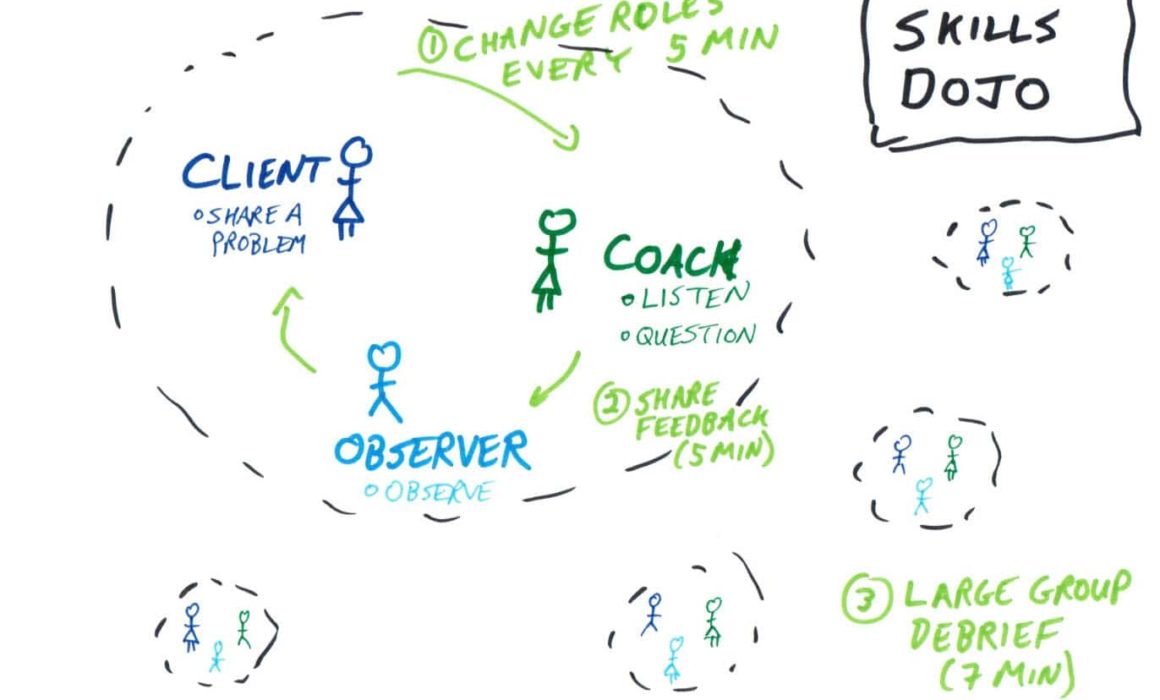
  • Explain Roles: Client, Coach, Observer
  • Explain timing and structure of the practice rounds

(27 min) First Round of Practice

  • 5 mins x 3 mini rounds (everyone rotates through roles)
  • 5 mins sharing within triad
  • 7 mins sharing with group

(27 min) Second Round of Practice

(2 min) Wrap-up

  • Action point takeaways – close eyes for one minute and think of how you will use these skills in the next week.

(6 min) Slack/Buffer – for possible late start or time overrun

Facilitator Tips

  • Prepare in advance flipcharts with:
    • The 3 roles
    • Timing of each mini-round
  • Bring a gong or bell to let people know when to change roles. Why? People get so far down the tunnel it is hard to get them to shift gears.
  • (Optional) Prepare a handout with a summary of the three skills.
  • (Optional) Prepare your own poster explaining the three skills.

Sources of Inspiration

Michael attended Rachel Davies Coaching Dojo at Agile 2010 and was curious about how to build upon its subject using aspects of the Yellow Brick Road game.

Coaching Skills Dojo can be considered a variant of The Yellow Brick Road – Agile Adoption Through Peer Coaching created by Portia Tung, Pascal Van Cauwenberghe and Duncan Pierce. The inspiration for this new game is to streamline it and create a more relaxed pace than the original Yellow Brick Road game. For example, the mini-rounds are extended by five minutes and there are only two mini-rounds rather than three in the original game. As well, we have introduced a learner-led mini-workshop at the start to remind and grow peoples understanding of the three skills.

This was submitted (but not accepted) to Agile 2011 as “Over the Rainbow: Coaching success through observing, listening and questioning” and has been subsequently renamed.

Feedback from First Run at Agile Games 2011

  • “It was great to bring specific focus on the skills involved in coaching: observing, listening and questioning. It is too easy to take this for granted.” – M.C.
  • “Made 2 really great contacts.” – L.L.
  • Rated 9.2/10 for usefulness at work.
  • As facilitator, it was very moving to see participants improve their skills in such a short time.

Comments (6)

Coaching with Photos

This is a guest blog post co-written with Christine Neidhardt based on a session at Play4Agile conference on coaching with photos. The session was based on an experiment with the Points of You – Coaching Game (German link) to find ways to use the photo cards with a group or team. And we did.

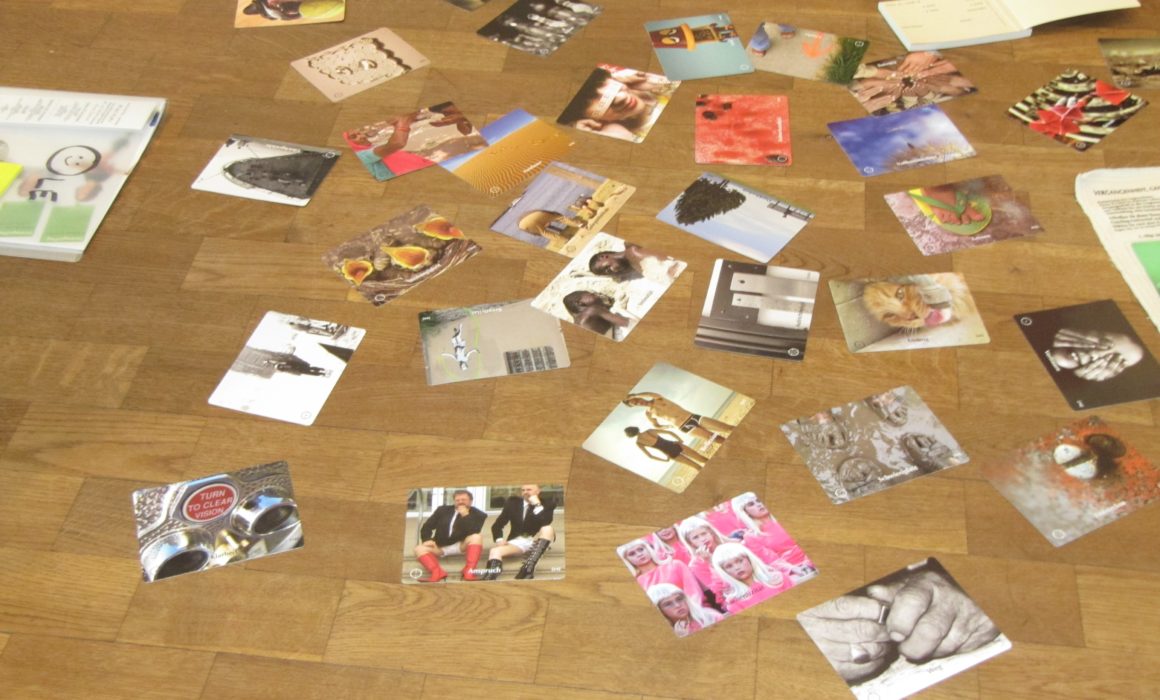
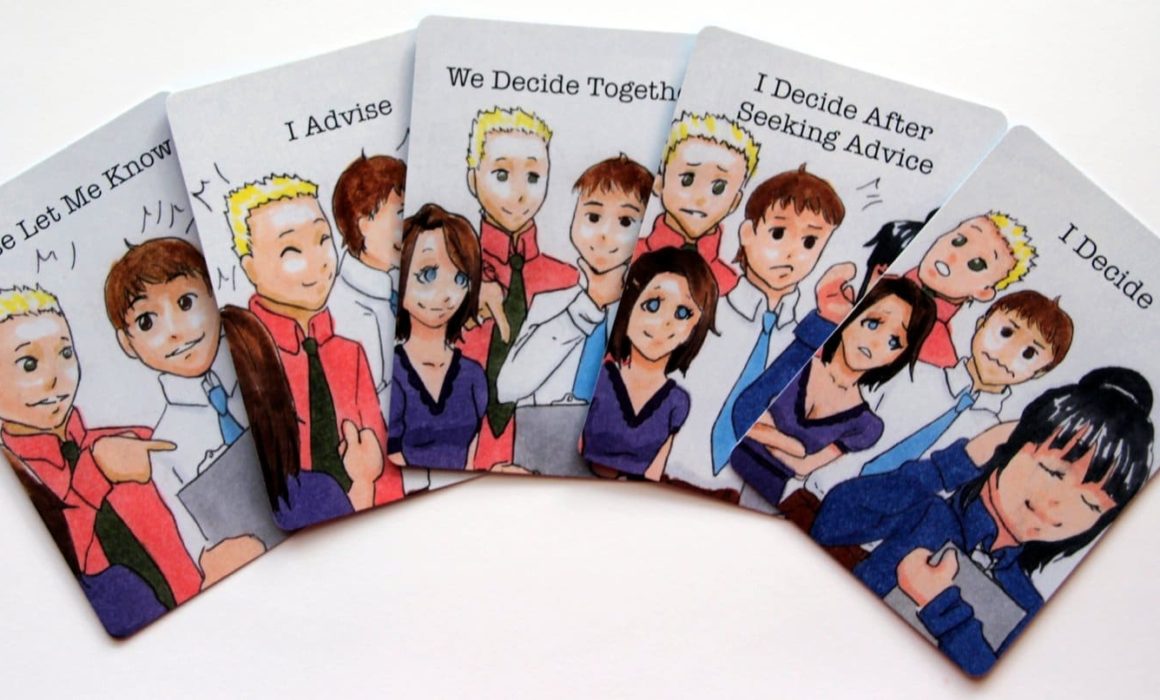
Here is a photo of some of the cards scattered across the floor.

The one-on-one Coaching Game

The CoachingGame is used as a creative support material for coaches and offers a variety of possibilities to work with. We started with a public one-on-one coaching session to show one practical case how to use  the CoachingGame and we were lucky that we had a person volunteering. We selected between four topics the game is offering:

  • Relationships
  • Winning and Loosing
  • Mindfulness
  • History, Present, Future

We decided for History, Present, Future. In a fishbowl arrangement, the practice client selected an important question for the session and we asked: what happened in the past, what happens now, what is the potential. The client selected three photos that represented each of the topics.

The cards do offer a photo, a word and a symbol. There is a companion book that explains each of the photos and provide stories to deepen the examination of the topic and offer additional perspectives and insights. There are five types of symbols (way, act, be, problems, opportunities) to which each of the cards belongs. Information which gives additional orientation. This together with an explanation cloth to position the cards to the questions, makes it all very comfortable to work with.

Creating Team Games

After the Coaching demo we formed two working groups to figure out how to use these cards in a group or team. This was the goal of the session and we came up with some pretty cool results in just 15 minutes.

Photo Reflection Game

One group created the photo reflection. We selected the Play4agile conference as topic and asked us, what was the past, present and what is the potential in the future. Everybody selected up to three  cards. Everybody presented his cards to the group. The foto helped to explain and gave new ideas.

Past (first column): We as Coaches who love games realized we were often hold by old habits, felt alone with our ideas and had to endure through tough times in the day to day work.

Present (second column): The conference was the place to be at least authentic and to find people with the same mindset, where there occured many oppurtunities and creativity is in full bloom.

Future (third column): Putting the new games into action was one of our goals, as well as being open to all that is possible. All could happen. Lots of people from the conference would like to see games as a usual tool being used like techniques as Scrum. Some of the people found it possible that they would find their vocation in introducing games and the results of the conference in their daily work.

If we would have had more time, we could have gone deeper, could have agreed on some cards which would be the most important or we could have made as well the second part of the shared vision game.

The Shared Vision Game

The second group used the time to focus just on the last question: the future.

  1. Select the topic. In our case it was our future expectations of the conference. It could be for your team or project.
  2. Have everyone pick a card that resonates with them.
  3. Confirm that everyone is comfortable with the other cards. Some people did not understand the card I picked and after explaining what it meant for me, they were OK with it. I even changed the photo by covering up part to make our shared understanding of the meaning clearer.
  4. Create a statement that incorporates all of the ideas.

Our Shared Vision Statement

We somewhat unexpectedly created a powerful shared vision of our expectations of the conference.

What Can We Still Learn?

You see, there are unlimited possibilites and maybe we have now lots of more ideas how to work with these visual tools.

Why does this work?

Michael, as an NLP practitioner, is a big believer in the power of the unconscious mind. And photos tap right into our unconscious minds so we get to what is really important.

In the book How Customers Think, there is a great technique where customers bring in a photo that they feel relates to the product. When they explain the relationship they give very rich information about what is important and why. It’s a great book full of research on brains and decision-making.

The game with photos works the same way. We allow people’s unconscious to get in the game by selecting a photo. This is much deeper than just visual expression or writing on a sticky note.

Leave a Comment

How to Facilitate a Great Game Debrief

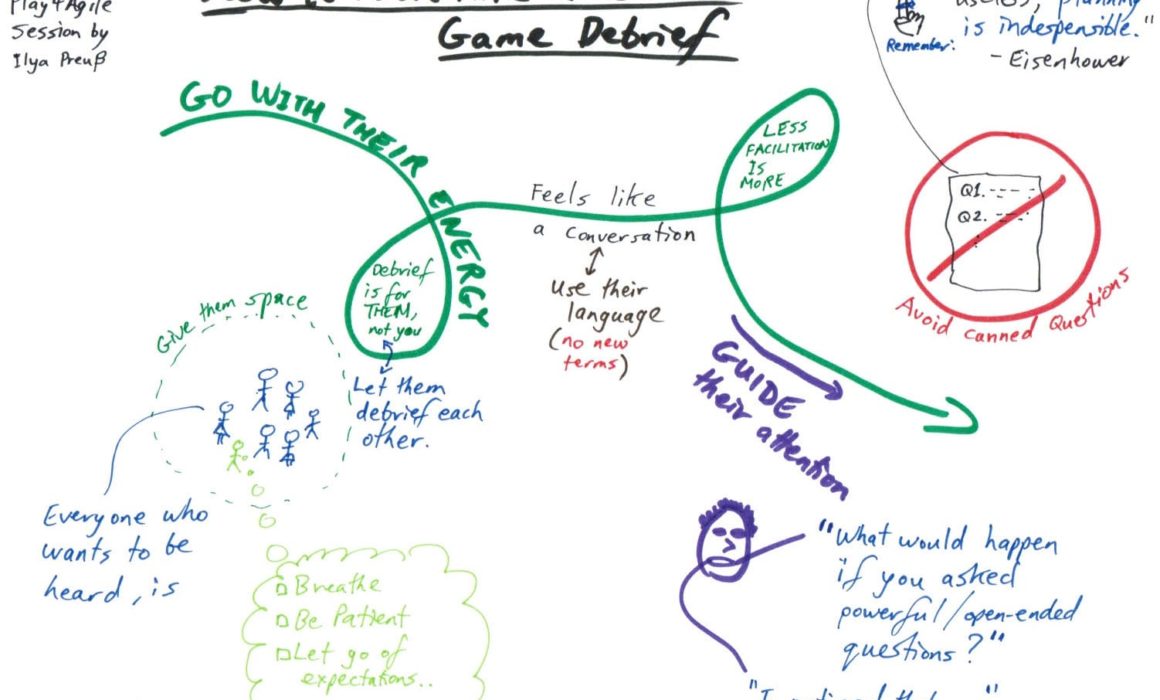
Ilja Preuß ran a peer workshop at Play4Agile on Tips for debriefing a game. Thanks to everyone for sharing such wonderful ideas.

I synthesized this into the visual note:

The main points are:

  • Go with their energy so that it feels like a conversation.
  • Less is more: Give them space so they can debrief each other.
  • Guide their attention through powerful questions and observations.

Original flipchart photos are page 1 and page 2. I didn’t capture everything so check them out too.

I was already able to apply some of my learnings when I facilitated a game debrief later in the conference. Thanks Ilja!

Comments (1)

Play with Lego for Strategic Results

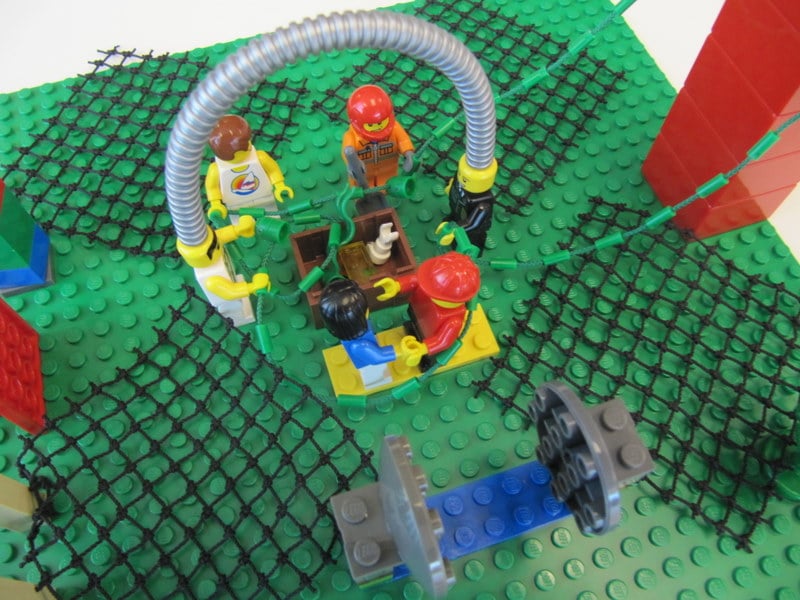
At XPDays Benelux I was fortunate to accidentally attended Agile Community Vision with StrategicPlay by Olaf Lewitz and Yves Hanoulle. If you are curious how you can use Lego to achieve strategic results, read on.

Ideal Team Member

One of the exercises was for each participant to build an identical turtle from a kit using instructions. We were told that the turtle represented an ideal member of a team and ask to add one part that represented what we thought was important. In my case, I picked a flower (see photo on right). For me the flower stands for individualism that is needed to have a strong team. I am sad I did not video record my explanation or take notes since I can’t re-access the profound insight I had when created my model.

You can also see all the turtles that the group created in the photo below. Even though some us picked the same Lego piece to add, the location and narration of the meanings were quite different. So, in this case you really need to hear the debrief to understand the meaning.

Agile Community Vision

The next exercise was for each of us to build our vision of the Agile Community using a large collection of Lego without talking. After building, we took turns debriefing. You can see the different models that people created below. Mine is the one in the foreground with a tall antenna and bridges to other communities. As I went through the exercise, I found that I was learning things about myself. This can be a very revealing exercise.

Check out a very short video where I explain my model.

Shared Agile Community Vision

In the next exercise we built a shared vision that incorporated ideas from the individually created models. As we did this we clarified and enriched our metaphors. It was a very interesting social/team exercise to work through the ideas.

There was only one rule to guide us: everyone had to feel comfortable with the model. If there was a part that did not work for them, we were to remove it.

Here is a short video where we took turns explaining parts of the model:

Comments (2)

Innovation Games® Workshop? Awesome!

For me, 2010 was a year for attending many conferences but I only did one planned training session – Innovation Games® Master Course with Luke Hohmann – and it was awesome.

I am writing this post to share with you a little of what happened. Below is a photographical tour of the 2 day workshop. You can click on the images to see a higher resolution image.

It all started with name cards

Who knew what a fun activity this could be? It’s not everyday that I get to use glitter glue …

Never enough wall space

With interaction knobs turned to “11″, the walls were covered with Big Visible Charts or Information Radiators. Note for Agile teams – you can never have enough wall space. A projector was only used for a little bit on the second day.

Grow the Product Tree

Grow the Product Tree is a variant of Prune the Product Tree where the participants create all the leaves. So no pruning, only growing. This is how to play the game if you want to generate lots of options.

Luke Explaining

Luke spent a lot of time telling war stories about using games. For me this was great. Lot’s of learning and gems. In the photo below we were discussing running parties and galas in online games.

Spider Web for Financial Services Product

Big paper = Big Ideas! Map out how your product interacts with related products.

When and where to Use Games

Here we see what games might be played to support a team at various points in the planning horizon. For example, at the strategy level, we might want to answer the question “What is our BHAG (Big Hairy Audacious Goal)?” and we might use the game Product Box to help answer this.

Same but for Product Development Lifecyle. For example, after the release of a product, we might want to answer the question “What do customers like about the product?” and we might use the game Show and Tell to help answer this.

The above diagrams show that all you need is an image and you can create a brand new game.

Where to find out more?

You can find out about the different Innovation Games® here.

Leave a Comment

Understanding Innovation Games®

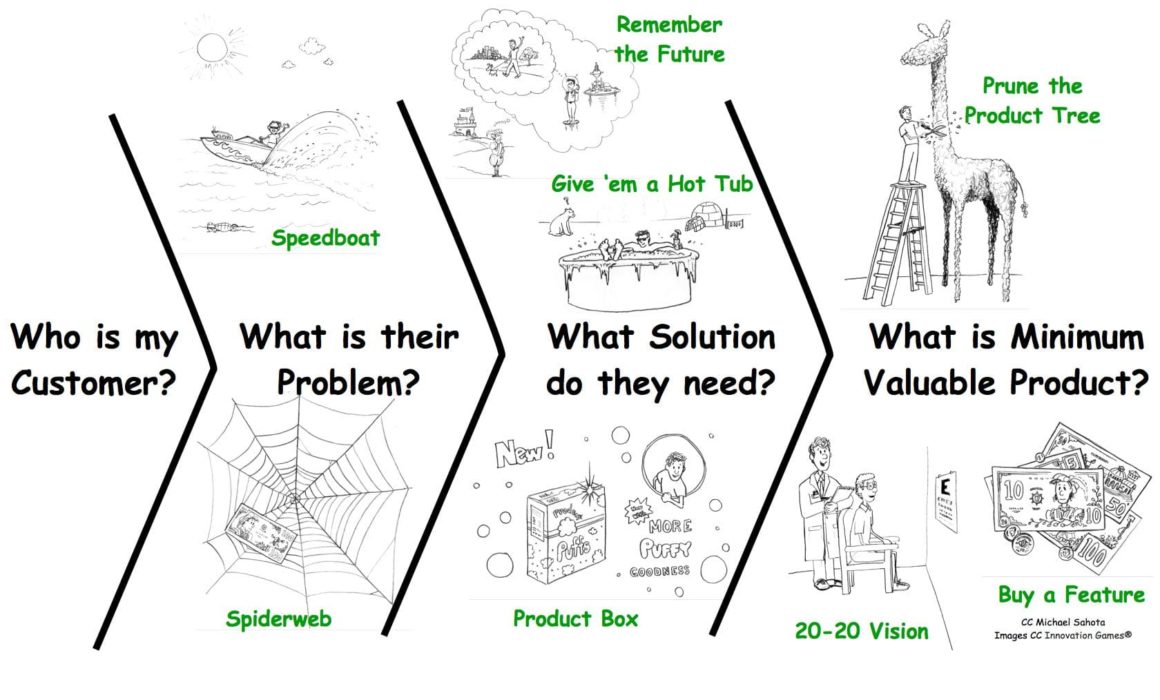
Here is the way one way to see Innovation Games® (Click for hi-res image).

The diagram came out out Luke Hohmann’s Innovation Games® Master class in September. In my search for order, I decided there were three main categories of innovation games:

  1. Generative – for generating new product ideas
  2. Prioritizing – understanding relative priorities of different features
  3. Understanding Product Use – all about how customers use the product today

In the diagram I have bucketed each game in it’s primary category. The one that resists this classification is Prune the Product Tree which can be very unstructured and generative (participants write features) or highly structured and used for prioritization (features are pre-selected). It all depends on who writes the leaves.

There are also other perspectives for viewing the games. Check out the book for perspectives based on prep time, scalability, etc. Another good resources is this one page summary of all the games.

A big thanks to Luke Hohmann for sharing the images under creative commons license.

Leave a Comment


       Certified Scrum Coach Certification
         XPToronto and Agile User Group