Temenos: Containers for Growing Relationships

“If we’re serious about exploring the world around us, we have to explore the world within us.” - Ken Robinson

(Joint post with Olaf Lewitz - Temenos Series)

The Temenos container provides a powerful mental model for understanding and improving relationships with others.

Often we do not consider the larger context of the situations we are in. When we explicitly look beyond the specifics of a conversation or interaction to the relationship itself, we may more easily achieve relational flow.

We use the term container to talk about the underlying fabric of our relationship with another person. The same notion can be used to understand groups we are part of as well as our relationship with ourselves.

Consider the diagram below illustrating how containers may be used. For example, we may wish to imagine our vision for the relationship, the baggage of our history or the roles we play.

Temenos Container


Roles We Play

Dave Snowden has frequently pointed out that one specific dimension of the complexity of human systems is our ability to change roles (containers) from one second to the other. For example, when my wife calls me at work my role changes from colleague to husband. One set of beliefs, principles and values is replaced with another, potentially conflicting one.

Each role we play applies to a specific context. We share most of these contexts with other beings. A container is the Temenos term to talk about these specific contexts. Within these containers we evolve the different roles we play in life.

When we consciously examine our containers we can evolve the roles we play. Or evolve ourselves so that we behave the same across containers – to our true authentic self.

What is a Temenos?

Temenos is a Greek word for a transformational container, such as a separate piece of land dedicated to a king or god. It is a contained space of spiritual importance. With Temenos we hold all our containers as a sacred enabler to connection and relation with other human beings.

The focus of this post is on the use of the container in the context of a relationship with another person and with ourself. The creation of a transformational Temenos container and how to leverage symbols of transformation will be the subject of another post.
Containers In Our Lives
In the history of our lives, these containers are formed: shared spaces for ourselves or others, each of which defines a unique identity (the role we play), unique habits we acquire, and adds specific emotional baggage to the load we carry around in our lives.

We spend our lives in different containers. Each of them helps us to grow and be more of ourselves. For every container, we have needs that we want fulfilled and expectations we feel obliged to fulfill. Every time those needs are not met (or we think we don’t fulfill the needs) we are hurt: we think we fail the container or the container fails us. Some examplesy of such containers:

  • Our self. This is the most important and challenging container for each of us.
  • The family we grow up in.
  • The friends we make, and lose, over the years.
  • Teams we join, and leave, workplaces, clients…
  • People who die.
  • Relationships we start, and finish.
  • Our children, the mutual unconditional love that challenges us and makes us whole.

All of these relationships, the roles we play in these and how they affect us can be framed as containers:

  • Containers we join (some deliberately, some by chance)—born into a family
  • Containers we leave (or that leave us)—divorce, death
  • Containers we enter—coming home from work
  • Containers we exit—leaving home for work

Olaf’s Story

When I created my first influence map and reflected on the containers which have been important in my life, I noticed I had unconsciously (though still deliberately) removed roles from my portfolio. For example, the relationship to my parents had transformed into a mutual friendship on eye level; same with my brother. I had effectively stopped acting as a son, and brother. Don’t get me wrong: we didn’t break up, the relationship became closer. Its quality had changed, and I noticed that not playing these roles gave me ease. So I thought: why not continue deliberately in that direction? How many roles do I want to and do I need to play? I haven’t found a definite answer yet. And I’ll stop being an employee soon, which is a step on this path.

Michael’s Story

One example of using the container model to improve a relationship is with my younger son, Sean. When I considered the whole of our relationship, I could see that I was failing him in providing attention to him as an individual (rather than as part of my pack of three kids). Once I had taken stock of the current situation and our history, I was able to create a vision for how I wanted our relationship to be. For this container, what I want is for me to really see him and for him to know that I really see the special, unique person he is. Our relationship has improved. And that for me is the whole point of containers: an opportunity to reflect and create a different path for ourselves.

Origins of Temenos

Michael-Siraj-OlafTemenos is a special kind of experiential laboratory (usually delivered as a weekend lab) that Siraj Sirajuddin has created over many years integrating diverse influences such as Buddhist, Islamic, Jesuit and Hindu spirituality, mythology and Jungian psychology. He’s been using these labs to support lean and agile transformations in his practice as an Organisational Transformation Mentor.


Upcoming Workshops

Ping us if you are interested.

Leave a Comment

Create Authentic Connections with Influence Maps

(Joint post with Olaf Lewitz - Temenos Series)

In the course of our lives, we all encounter events that shape us, allow us to change and grow, that have made us who we are. We don’t tend to acknowledge or appreciate these events, and we rarely share them. Understanding our own path, reflecting how we became who we are, which influences determined what we value and what we want, is a powerful source of personal growth. We better understand our own unique identity, our relationships with others and the related emotional baggage to the load we carry around in our lives.

Influence Maps is the module in a Temenos lab that allows you to reflect, visualise (map) and articulate your personal history, and share it with the group—as detailed and deep as you choose to. Like every Temenos module, Influence Maps works on its own, too.

Influence Maps

Influence Maps (the key/main part of a Temenos lab) are used in group workshops to:

  1. Create deep personal learning and growth,
  2. Connect with other participants and develop a deep level of trust,
  3. Allow ourselves to be seen and accepted as human beings,
  4. Create the opportunity for participants to heal one another’s emotional wounds.

An influence map is a visual depiction of the influences in our lives that have led to us becoming the person we are.

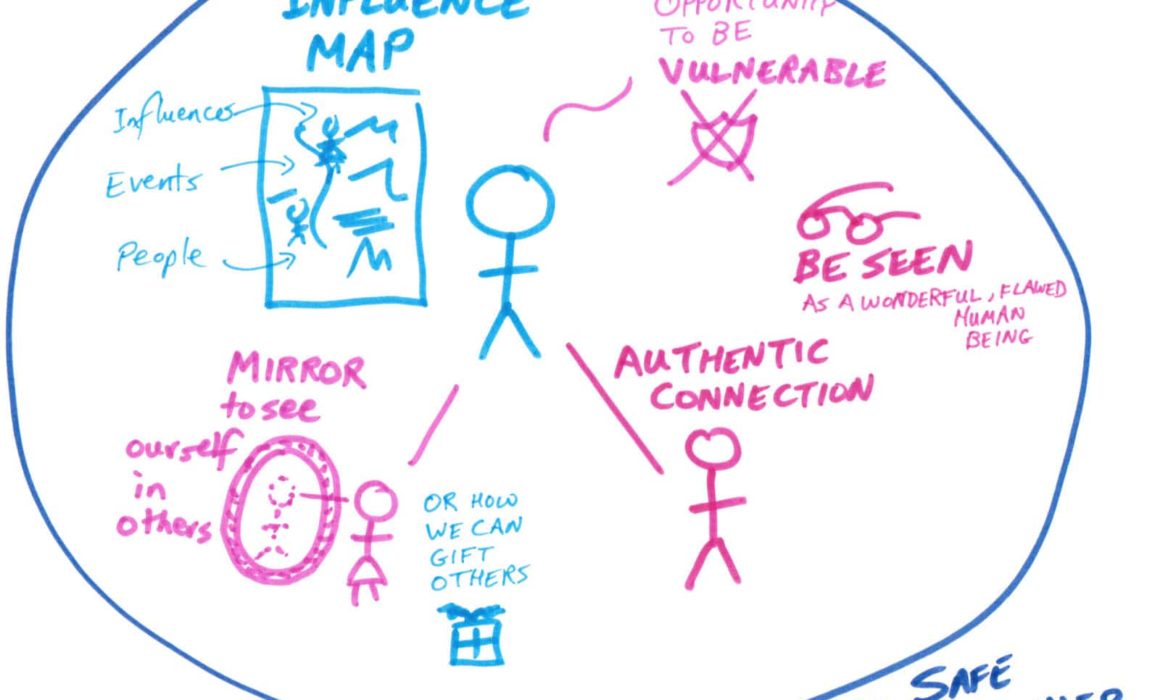
The diagram below shows the main elements of Influence Maps and how the Tememos container serves as a safe and caring environment.

Influence Map Infographic

Influence Maps help you understand and appreciate your past. This will hurt as you share past trauma, and makes you ready to be healed.

The healing and personal growth results are emergent from the container we collectively create. A high-quality container will lead to a myriad of opportunities.

Don’t mistake the Temenos’ healing effect with therapy. While we all have our unique history and individual and specific things we did and had happen to us, the strategies we use to deal with them tend to show common patterns. Many people who lose a dear person, for example, go through a stage of denial. Through sharing our history we create resonance with others who’ve been employing similar strategies.

“People heal from their pain when they have an authentic connection with another human being.”

Marshall Rosenberg

Example Influence Maps

Before we explain the workshop setup and mechanics, here are some example influence maps.

Michael explaining his Influence Map

Michael presenting his Influence Map

Olaf explaining his Influence Map

Olaf presenting his Influence Map

As influence maps are a creative expression of one’s identity, there is no one “right” way to do them.

Workshop Setup

Trust. Safety. Caring. These are the properties that participants are asked to create and nurture in a Temenos. The role of the facilitator is to work with participants to have these properties rapidly emerge. For example, supporting and encouraging vulnerability so that we can speak about the issues that shame us and hold us from our potential.

From our experience, the group size should not exceed 6-8 voluntary participants who are interested in personal growth.

Workshop Mechanics

The first exercise in a Temenos lab (and the one taking up most of the time) is drawing and sharing of Influence Maps. The process is very simple:

  1. Introspect: Through a guided meditation with music, we ask you to reflect on your life. Use your timeline to guide your memories. Imagine a trusted friend asked you: What do I need to know about you that will help me understand who you really are? Ask yourself: What about me do I not dare to tell anyone? How much of that might I be willing to share to understand myself better?
  2. Visualise: Each participant uses a large flipchart paper and creates their life’s story with an eye towards defining moments and key influences. Many people find it useful to draw a timeline, but any expression of your deepest self will work. It’s not about the drawing, it’s about the story you tell.
  3. Articulate: Participants take turns telling their stories through their influence map. Before any person shares their story, another participant will set the stage for her, to initialise the Temenos: “Sit down, slow down, breathe, and focus on the whole person who will present herself.” Then share your story with the group. The group will help you understand yourself better: You mentioned <…>. Could you slow that down for us? How did that make you feel?
  4. As a member of the group (or a facilitator): Observe for patterns. Participants are able to help each other learn and heal in two ways. When we are similar in a trait, we can see ourselves better through the other person. One person struggling with a loss will be able to help another: “If you can forgive yourself for doing <…>, I can forgive myself for doing <…>”.  An example from a recent Temenos: “If you can forgive yourself for being an average parent and making mistakes, then I can forgive myself for doing the same.” When we are dissimilar, we can see what is missing in ourselves or help others see what they may be missing.

At least two people in the group should know how to ask open (coaching) questions.

The Influence Maps add depth to the Temenos. Without them you will still identify improvement options, and have less probability for moments of true transformation.

Healing Conversations in Buddhism

Thich Nhat Hanh  has this to say:

Deep listening is the kind of listening that can help relieve the suffering of another person. You can call it compassionate listening. You listen with only one purpose: to help him or her to empty his heart. Even if he says things that are full of wrong perceptions, full of bitterness, you are still capable of continuing to listen with compassion. Because you know that listening like that, you give that person a chance to suffer less. If you want to help him to correct his perception, you wait for another time. For now, you don’t interrupt. You don’t argue. If you do, he loses his chance. You just listen with compassion and help him to suffer less. One hour like that can bring transformation and healing.

Testimonials

Inspiring, Healing, Present. Michael’s presence facilitates the creation of a strong container to support making the connection from the heart, not the mind. The influence map is a powerful tool for building connection.” – An Agile Coach

Moving, Revealing, Balancing. I found that deep connections to other human beings can be found and made a lot more often than I expected. A safe space was created and held all the way through it.” – Melanie Meinen

Origins of Temenos

Michael-Siraj-OlafTemenos is a special kind of experiential laboratory (usually delivered as a weekend lab) that Siraj Sirajuddin has created over many years integrating diverse influences such as Buddhist, Islamic, Jesuit and Hindu spirituality, mythology and Jungian psychology. He’s been using these labs to support lean and agile transformations in his practice as an Organisational Transformation Mentor.


Upcoming Workshops

Ping us if you are interested.

Leave a Comment

Temenos – A Workshop for Healing, Connection and Relational Flow

(Joint post with Olaf Lewitz)

What is Temenos?

Temenos is a Greek word for a transformational container, such as a cut off piece of land dedicated to a king or god. It is a contained space of spiritual importance.

Temenos is also the name of a special kind of experiential laboratory (usually delivered as a weekend lab) that Siraj Sirajuddin has created over many years integrating diverse influences such as Buddhist, Islamic, Jesuit and Hindu spirituality, mythology and Jungian psychology. He’s been using these labs to support lean and agile transformations in his practice as an Organisational Transformation Mentor.

In a broader sense, Temenos is also a philosophy and mindset.

In brief, deep bonds and healing result from exploring each other’s personal history (how we became who we are) and visions (who we want to be). We use the conceptual model of a container to help us perceive and understand our relationship with ourself and other, so that we can consciously let go of emotional baggage and create strategies that serve our and others’ needs in an exercise we call Clean Slate.

Temenos Posts

This is the start of a series of multiple blog posts that Olaf Lewitz and I will publish over the following weeks with the help of Siraj and other Temenos practitioners.

Temenos Outcomes and Mechanics

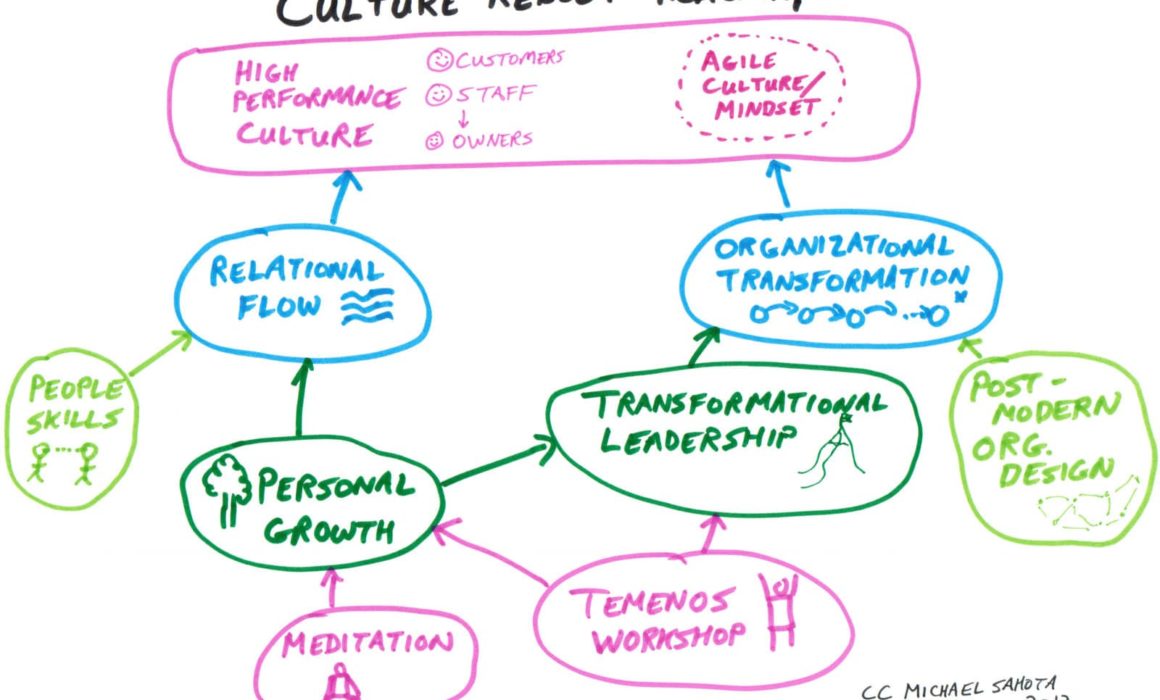
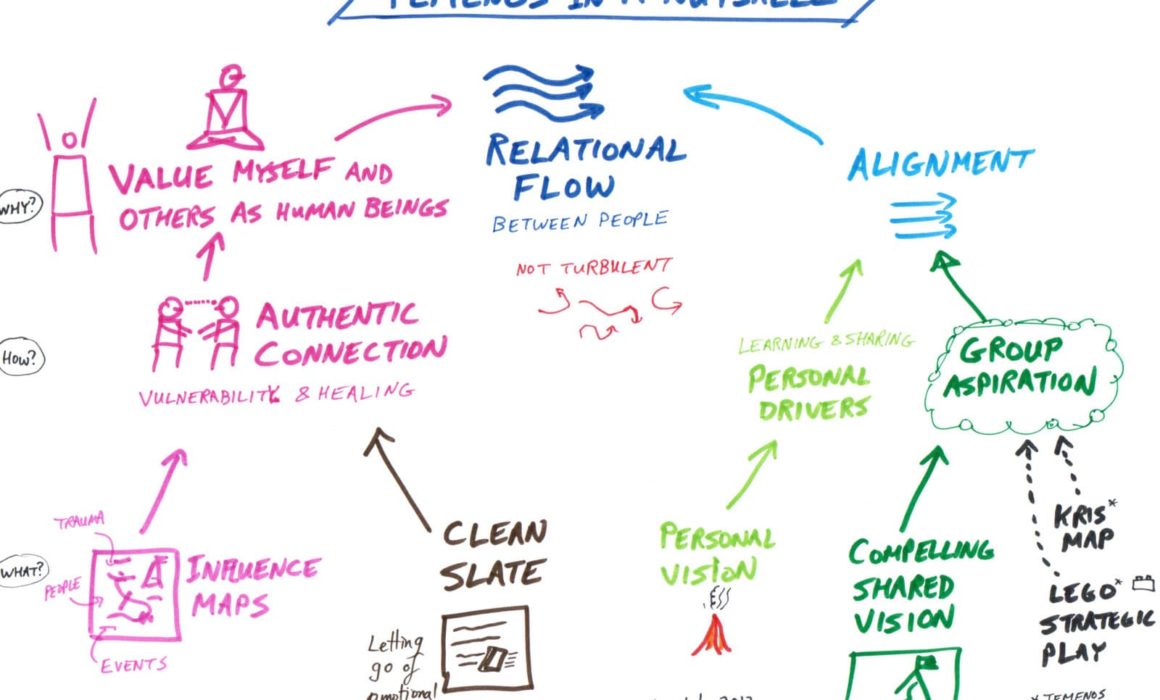
The diagram below is intended to be a sketch rather than a definitive guide of the why, how, and what of Temenos.  A key objective of Tememos is to get people into a state of relational flow where they are aligned and don’t keep bumping up against people’s wounds and challenges. The bottom items (what) are the actual activities that are conducted in a Temenos.

Temenos In a Nutshell

Healing ourselves using authentic connections

  • Influence Maps – sharing what our influences are

Growing strong containers

  • Clean Slate – getting rid of baggage
  • Containers – how we create safety and opportunities for transformation

Building Authentic Connection through Sharing Perceptions and Appreciations

  • Temenos Feedback – how we help people see their better selves
  • Update Strategy – how we deliberately modify our relationships with others

Alignment of Personal and Shared Visions

  • Who do I want to be? Where do I want to be?
  • Where do we want to be?

Why Temenos?

Through Lean/Agile and other approaches it has become clear that high-performing environments (containers) live on a foundation of trust, safety and respect. Temenos lab is an experience centered around fostering the relationships between beings. This is helpful for people who work together as a team. In particular it was designed to help leadership teams go first in the transformation of their organisations.

Why Attend Temenos?

Attending a Temenos lab can serve multiple purposes. Without limiting your options, I’m listing a few common intentions that participants had in attending a Temenos lab or organising one. Siraj hosts monthly labs at Kayser Ridge in West Virgina, about 2h drive from Dulles airport (Washington DC). We’re planning to organise Temenos labs in Europe later this year. Ping us if you’re interested!

Temenos for Your Personal Growth

The endless curiosity and passion we’re born with gets dampened when we meet the limits of the context we grow up in. This can hurt, and deviate us from our path of growth. Attending a Temenos can help you clarify for yourself what you want, who you are, who you can and want to be, and help you devise a strategy for your success.

Temenos for Your Team

A team’s effectiveness and performance is strongly correlated with its members’ ability to articulate what they think and feel, say what they want and help each other achieving it. Attending a Temenos lab together gives you this option, and may lead you to create a shared vision.

Temenos for Your Leadership Team

The leadership team of an organisation is a special kind of team, as the product you co-create and grow is your organisation. Communication habits and behavioural styles within this team give an example to all people in your organisation. Achieving a clean slate and shared vision in the leadership team, nurturing your ability to create and sustain authentic connections to other beings, will greatly improve your effectiveness in helping your organisation achieve its goals.

Testimonials

“The Temenos session at Play4Agile 2013 with Olaf Lewitz and Michael Sahota helped me to see more of my person and talents and my intuition which helps me in my work. I got enriched by opening my inner self in the deep process in this secure container. I had the impression that I entered a room where we all are in connection and help us to see ourselves with all our aspects. The process allowed and invited me through getting in resonance to the stories of other people to heal my wounds and to see that I’m not alone. Now, I have a better understanding how it feels that we are all connected.” - Christine Neidhardt, Coach, Nürnberg

“The Temenons workshop gave me a lot of new insights to recognize who I am and what made me the person I am today. It connects different experiences in my life with strengths & weaknesses of my character and the environments (containers) I live in and grew up to a whole picture. A picture of different colours, structures and signs of beauty and ugliness. A picture that shows me who I am and that I can be what and who I am.

Especially the influence map was one of the tools that showed me in a very simple but effective way which things, persons and experiences have influenced me in the past but also in the present. The method of the influence map opened my mind and my heart and I guess I have shown more of my fragile personality than I wanted to show.

Maybe it’s hard for the other people in the workshop to deal with such a high level of openness. But I have always reminded me, that on the first hand I don’t do it for the other people, but I do it for myself to recognize myself better. If I recognize things and structures in me, it helps me to understand people, their character and structures better. So I can consider it in my daily work with them in my way to communicate with them and solve problems.” - A Scrum Master about a Temenos lab Olaf convened at a client

Further Writing by Others

More people participating in Temenos labs have been publishing their experience:

(if you know of or have written a blog post about a Temenos lab experience, please ping me so that I can complete this list.)

Upcoming Workshops

Ping us if you are interested.


Leave a Comment

The Power of Vulnerability

Brene Brown had an amazing discovery: The people who have love and belonging believe they are worthy of love and belonging. These people, dubbed the “wholehearted” were able to overcome the shame issues that limit people’s lives. This post is based on Brown’s video The Power of Vulnerability and in her book The Gifts of Imperfection.

The wholehearted  have a set of common traits shown in the infographic below.

Vulnerability

The definition of the word vulnerable is “susceptible to physical or emotional attack or harm”. How can this be a good thing?

At her TED Talk Listening to Shame, Brown surveys the audience to show that people see vulnerability as pure courage – as long as it’s someone else!

Browns research shows that practicing vulnerability is essential for building the social connections required for living a life of joy and belonging. We have to risk being hurt in order to build strong connections with people. Yes, you do have to talk about that difficult issue if you want a strong relationship. Yes, you do have to ask that person out and risk rejection to make progress.

Many organizations are concerned about how to bring creativity and innovation to the workplace. Brown argues that vulnerability is the birthplace of creativity, innovation and change. How people inter-relate and function as a social network is at the core of this.

The following three elements are all necessary aspects of vulnerability: Courage, Compassion, Authenticity.

Courage

Courage is not about heroics and it’s not about a character trait. It is about regular practice in daily life. Each day we have many opportunities to practice our courage: to do the right thing, to be vulnerable, to be authentic. It can be as simple as telling someone that you don’t want a meeting that you don’t think is valuable – even though you know it may lead to conflict. It may be in some areas of your life you are very courageous while others could use work.

We are imperfect. We all want to be seen as good, fair, reasonable. And yet the reality is that we are human, not perfect, and we make mistakes. We forget. We ignore our inside voices telling us what is right. The wholehearted not only recognize their imperfections, but see them as part of who they are and embrace them lovingly.

Compassion

Compassion is a deep form of empathy where we co-suffer with the other person. Pema Chödrön writes “When we practice generating compassion, we can expect to experience the fear of our pain. Compassion practice is daring. It involves learning to relax and allow ourselves to move gently towards what scares us.” Wholehearted living requires that we be compassionate to ourselves as well as others.

I have noticed over the last few days as I have written about empathy and shame, I have room for improvement in practicing compassion towards myself. After a troubling event, I immediately went into the trap of “looking on the bright side”. When I noticed this, I slowed down and gave myself the grace to experience a flood of emotions around the issue. To allow myself to be heard and acknowledged. It was difficult in the moment but allowed me to discharge the feelings so they did not impact the rest of my day.

A critical piece of this is kindness to ourselves. Brown states: “We can only be kind to others to the extent that we can be kind to ourselves.” I have kids and this struck me through my soul like a sharp burning knife. At the time I was aware I had low levels of self-kindness, so the implication that I could not be fully kind to my children really hurt. This truth, has led to a year+ long quest for self-kindness. (But that’s another post).

Authenticity

Authenticity is about being true to who we really are 24 hours a day. It means that we know who we are (imperfections and all) and let ourselves be seen that way. It means that we say and do what our true identity requires. And yes, this means taking on risk. But that is what we need to do to fully reclaim our lives.

I would like to add Brown’s Caution: “If you trade in your authenticity for safety, you may experience the following: anxiety, depression, eating disorders, addiction, rage, blame, resentment and inexplicable grief.”

Closing

The good news is that there is a path forward for fully living our lives. The bad news is that there is a world of difference between knowing what you need to do and knowing how to do it. There are some guideposts (starting places) for learning how to make changes in your life in The Gifts of Imperfection. If you are interested in making changes in your life, it is best to start with Brown’s first book I Thought it was Just me since this is much more helpful in understanding what challenges you are up against.

I would like to close with the following quote from Brene Brown: “Yes, I am imperfect and vulnerable and sometimes afraid, but that doesn’t change the truth that I am also brave and worthy of love and belonging”. (p.1)

Acknowledgements

I thank Brene Brown for her excellent job modeling the power of vulnerability and for helping me in my life. I would also like thank everyone who participated in the “Gifts of Imperfection” meetup group for a safe space to practice vulnerability.

Comments (1)

Understand Shame to get to Root-Cause in Your Life

In this post I am going share a book that has changed my life in deep and profound  ways: Brene Brown’s I thought it was just me (but it isn’t).

A good friend expresses the power clearly: “With this book, I am finally able to get to the root-causes of the problems in my life.

If you want to play a leadership role in building great workplaces or you want to live a richer life, then read on. One word of warning: the core of the book is about the topic of shame. We tend to avoid and ignore this topic since it is uncomfortable. But that’s why it is key to understanding what’s going on in our lives.

Shame

Brown created this definition (p.5):

“Shame is the intensely painful feeling or experience of believing we are flawed and therefore unworthy of acceptance and belonging.”

When we are in shame, we are in deep emotional pain and experience strong physical symptoms. In shame we feel like we have little or no value as human beings. Brown argues that shame has no positive purpose in our lives – it does not accomplish anything for us.

Guilt is a different story. With guilt we believe we are a good, valuable person, but have made a mistake. Guilt helps us correct our mistakes. It is very useful and has a positive effect in our lives. The confusion arises since much that we label as “guilt” is actually shame.

SHAME is at the centre of the infographic below. We will first consider the causes and then the outcomes of shame.

Unwanted Identities and Shame Triggers

Brown argues that Unwanted Identities are key drivers of shame. There are many influences in our lives that tell us:

  • Who we should be
  • What we should be
  • How we should be

See diagram (p.19) on right from the book (used without permission). Hint: click on it to get larger image.

Twelve categories for shame drivers emerged when researching women: appearance/body image, motherhood, family, parenting, money/work, mental/physical health, sex, aging, religion, being stereotyped/labeled, speaking out and surviving trauma. (p. 73)

For men, many of the categories in the list apply, but there are some key extras around the need to look strong and succeed. Weakness, failure, and fear often lead to shame.

Each of us has a unique set of ways to feel shame. To survive and thrive, the first step is to identify our shame triggers. These are the the unwanted identities that impact us. Shame is about how we wish to be perceived in the world. Here are the two questions to ask to help understand your triggers (p. 83):

  1. I wish to be perceived as __________, ____________, ___________ and __________.
  2. I do NOT want to be perceived as __________, ____________, ___________ or __________.

When you do this exercise, please take special measure to be kind to yourself. We are all human.

Consequences of Shame

The top part of the infographic above shows some consequences of shame. In addition to feeling unworthy and inadequate, we loose any sense of safety, suffer from fear and with it our ability to take effective action. We feel disconnection from those around us and believe that no one will understand or appreciate us for who we are. Shame is an extremely debilitating state where we are very unresourceful. What can we do to recover?

A trap we fall in is to use blame as a “way to discharge hurt and pain”. When we blame others we shore up our emotions and it feels better. Sadly, this does not resolve the shame and only serves to mask our painful emotions.

How to Manage Shame

We can never be truly immune from shame, but we can develop what Brown calls “shame resilience”. Her prescription is:

  1. Understand our Shame Triggers – as discussed above, introspect on yourself when we are calm and capable.
  2. Practice Critical Awareness – in the moment, recognize that you are feeling shame and say it out loud or in your head.
  3. Reach Out – Call someone who is able to be supportive and listen with empathy around your issue. Do it immediately.
  4. Speak Shame – Tell the supportive person how you are experiencing shame and believe them when they tell you that your are a good person.
I have practiced this for over a year and it has worked wonders for me. Like all of us, I experience shame issues on a regular basis. The difference is that I now call people so I can recover and get back to living my life. This one thing has made a huge difference in my life.
Brown says that “Empathy is the opposite of shame”. Speaking shame is critical since empathy dissolves and diminishes the effects of shame. Sadly, when we are in shame, we have a diminished capacity to practice empathy so we cannot help others. Fortunately, empathy can be learned.

Closing

I read the book a little over a year ago and it triggered very positive sweeping changes in my life. The power of the book is in providing clarity in understanding a key problem and a simple model to make changes. The rest is hard work.

Acknowledgements

I would like to thank Brene Brown from the depths of my heart. This book has profoundly altered my life for the better. And everyone I touch.
Thanks to Suzanne Daigle for organizing a global conversation on Brene Brown’s book The Gifts of Imperfection and inspiring me to create a meetup group.
I would like to thank everyone who participated in the “Gifts of Imperfection” meetup group. I appreciate everyone sharing stories of shame and for listening with care and understanding.
Photo of woman in shame comes from Building Your Resilience to Shame by Margarita Tartakovsky. Check it out – it’s a great article.

Comments (2)

Empathy Workshop – Results and Instructions

This past Fall I delivered a training module on Empathy as part of a day long communication and teamwork training. In this post, I will give you step by step instructions on running an empathy workshop as well as share some interesting results from my session. Please see How to Express Empathy – Avoid the Traps! for my understanding empathy.

Let’s start with the workshop results.

How to Express Empathy

Comments:

  • Sharing or relating experiences. DANGER! DANGER! It is easy to use this to avoid expressing empathy – see How to Express Empathy – Avoid the Traps!. It is only after you have expressed empathy already that you can share something that shows you understand them. Good: “I can only imagine how difficult this time is for you. I know had great difficult time dealing with the loss of my mother.” Bad: “YeahIt took me a while, but I got over it.” (implies that they need to start recovering and that they need to ‘get over it’”.
  • Unless you can tell the future, it is not helpful to say “It’s going to be OK.” A better alternative is to say “You are OK” to acknowledge them in that moment. This is to validate them as human beings – “Yes, I hear  and understand that you did that and you are OK as a person. It could happen to anyone.”

How to AVOID Expressing Empathy

Comments:

  • We actually had a good laugh while people recounted these. I imagine this was because we all had committed these acts at various times.
  • Offering a solution or advice without permission can be considered a form of violence. The easy fix is to ASK for permission to provide advice or a solution. e.g. “Hey, do you just want me to listen or are you soliciting advice?” or “May I offer you a suggestion?”

Conclusions

We all have the basic understanding of what empathy is and what it is not. It turns out that traps and our attention are the key limiting factors in empathy practice.

Workshop Format

  1. Opening. Ask people to describe what empathy is. The goal is to get everyone oriented around a working understanding, not a crisp definition. Optional: ask or brainstorm why empathy is useful.
  2. Break into small groups to list behaviours on a) How to express empathy, b) How to AVOID expressing empathy. Let the groups go until it looks like they are running out of ideas.
  3. Large group sharing. Write each question on a flip chart. Have people shout out answers. Give time for large group discussion of items.
  4. Test items for group support. We used decider protocol for seeing if there was consensus around items to see if everyone agreed that they were correct. This allowed the group to come up with their own operational definition of empathy.
  5. Discussion of tricky items such as sharing or relating experiences.
  6. Practice giving and receiving empathy by forming pairs and taking turns telling stories.

Acknowledgements

I would like to thank the participants of the WEAO new professionals organization who created the content shown in the photos. I would also like to thank Andrea Tomasini for organizing the train the trainers event at the Atlanta Scrum Gathering that allowed me to develop this workshop.

Comments (2)

How to Express Empathy – Avoid the Traps!

It was the Fall of 2011 and I began to cry as I was reading Brene Brown’s book I thought it was just me. I discovered that at age 42 I was unable to express empathy. This came as a huge shock.

In this post you will learn the common empathy traps that we tend to fall in. Once you know the how to avoid the pitfalls, you’ll be ready to start building your emotional muscles. Fortunately for us, awareness and a little practice goes a long way to improving empathy.

Why care about empathy?

The practice of empathy builds trust and increases safety in your family and work environments. It supports the social fabric required for communication and shared activities. A world with empathy is nurturing and supportive – it creates an environment where people can be creative and take risks.

Empathy Traps (Anti-patterns)

Most of us have a basic understanding of how to express empathy.

The HUGE PROBLEM is that we are really good at BLOCKING EMPATHY to protect ourselves from feeling.

Imagine someone is in emotional distress. By blocking their emotions from our reality, we can avoid acknowledging and connecting to their pain. In the short run, this is great – we avoid pain. In the long run, we destroy the fabric of our relationships and our environments.

Three common traps and pitfalls are indicated in the diagram below. I am (sadly) an expert in the use of each one and am still working on being authentic and not running these anti-patterns.

Empathy - Pitfalls and Traps

Trap #1: Even Worse – the basic idea here is to compare the persons’s problem with someone else’s problem that is even much bigger. On the surface this may seem like we’re helping them: we’re letting them know that their problem is not that substantial and that surely this will help them see how unimportant it really is. What we are really doing is that we are saying that their problem and feelings are invalid or unworthy. Brene calls this “stacking the deck” and give this example from being trumped in cards: “I’ll see your ‘drunk mother’ and raise you a ‘drug-addict sister’”

Trap #2: Look on the Bright Side – in this approach we ask people to focus on the the positive outcome of the situation. Remember the saying “Every cloud has a silver lining?” or “The glass isn’t half empty, it’s half full.”  While I believe strongly in both of these statements and the related NLP technique of reframing, these have no place whatsoever when seeking to express empathy. When we focus on the positive, rather than acknowledge a person’s feelings, we ignore and dismiss them as unimportant. The net result is that we invalidate the other person. Hint: once someone feels fully heard and supported in their emotion, it may be  it may be appropriate and helpful to help them see the bright side.

Trap #3: Problem Solving – rather than be with the person in an emotion, we immediately jump to problem solving mode: How can we fix this problem? Typically, we start by assuming the person has invited us to solve their problem by telling us about their situation. (Why else would they tell us?) With this trap, we avoid acknowledging or recognizing the emotion and keep it just to the facts of the situation. We discuss how the situation came to be so it can be avoided in the future.

What to do about this?

  • Notice when you are running these anti-patterns and STOP TALKING. Saying nothing is much better than falling in these traps. Rewind the conversation if you need to. It’s never too late to go back.
  • Be kind to yourself. You are human like the rest of us. You’ve probably been running these patterns for years and years – it’ll take time to get better.
  • Take a deep breath and practice your empathy muscles. Yes! You can learn these skills. See below for one way to do this.

 Four Elements of Empathy

The following infographic show four elements of empathy as defined by Theresa Wiseman:

These are:

  1. See their World – to be able to see the world as others see it. This mean that you cognitively understand what they are saying and can see it from their point of view.
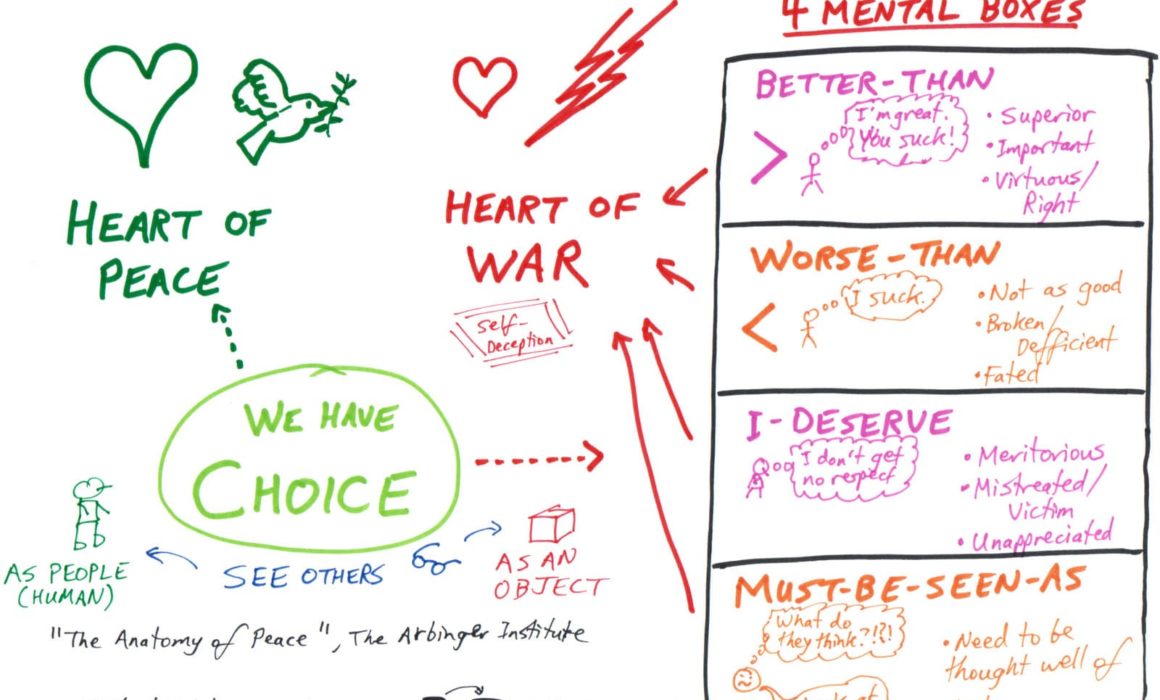
  2. Appreciate them as Human Beings / No-Judgement – to be nonjudgmental. I have restated the original “non-judgmental” in the the positive so it provides an actionable checklist. Judgement is actually another trap. We go into judgement to discount the persons situation so that we can avoid experiencing their pain. For us to express empathy, we need to see the person as a human being – someone who is valuable in their own right. Warning: this can be very difficult to overcome. I have an upcoming post on the “Anatomy of Peace” that will help clarify.
  3. Understand Feelings – to understand another person’s feelings. We need to get in touch with our emotions in order to truly connect with another person’s feelings. There is lot’s of brain research on mirror neurons and how we are neurologically wired to relate to other human beings. A common reason to skip this element of empathy is that we don’t have our own emotions sorted out. So, you may need to do some of your own mental housekeeping in order to be in a place where you can acknowledge other peoples feelings.
  4. Communicate Understanding – to communicate your understanding of that person’s feelings. The final element is that someone feels like they are understood – that they are seen and heard. This part for me has been a real struggle since I often don’t know what to say. Here is a great phrase from Brene Brown that can be used verbatim or as a starting point: “It sounds like you are in a hard place now. Tell me more about it.”

My Experiences with Empathy

It has been a little over a year since I developed a clear intent to increase my practice of empathy.

The good news is that I am much better at it. Over the last year, I have seen many people touched by the simple act of listening and just being there for them. It is so simple and so powerful.

The bad news is that I still struggle at times. I respond without thinking. Or my own feelings or wounds interfere with my ability to see someone else as a valuable human being. Continued and persistent success with empathy requires higher levels awareness of ourselves as well as healing of past trauma.

The ugly news for us a a society is that the empathy deficit is very large. I have noticed that it is commonplace for people to avoid emotions and empathy altogether. Many are lacking empathy skills and, far worse, not even aware that they are missing.

I encourage you to make a difference in the world. Practice empathy on your own and tell others about how they can too.

Acknowledgements

I am deeply grateful to Brene Brown for creating such a wonderful book - I thought it was just me (but it isn’t) - it has helped me in so many ways. The subtitle of the book is “Women Reclaiming Power and Courage in a Culture of Shame”, but men are in just as desperate need for reclaiming empathy and courage in a culture of shame.

Thanks to my dear friend Olaf Lewitz who suggested I read Brene’s book which has launched me on a tidal wave of change. I would also like to thank Pierre Lagacé and my “Gifts of Imperfection” meetup group for a chance practice empathy.

Comments (12)

Working with Systems of People

This post is about some important thoughts on working with organizations that I learned from Michael Spayd, co-founder of the Agile Coaching Institute, some time ago. A key part of my learning is about the value of acting as a mirror to a team or organization when working as a coach, influencer or internal change agent.

Systems are made of People

The infographic below summarizes key elements.

Act as a mirror

Michael expressed the effectiveness of a coach who acts as a mirror to reflect a system back to itself. This can help a system become more aware of itself and act with choice. He gives the example of asking – “Do you want to be a great team?” and noting that the choice is up to them.

A powerful exercise is to ask the team to visualize themselves as if the team were an entity. This can be used to guide the team to a powerful future state.

A final word of caution is not to try and “fix” the team. Any lasting change requires that they heal themselves: it is critical that we see them as resourceful and capable to facilitate this. The alternative is to leave the system in a “better” state, but less capable of learning and growing than when we started.

A variety of differences in perspective can be used to mirror what is happening to drive insights and learning: management perspective vs. staff, present vs. past or future, team vs. group.

Look at the larger system for solutions

The concept of a holon can be used to think about what level of the organizational we are considering: individual, team, group or company. The central idea is that problems can only be solved at the next level up. Wikipedia has this definition: “A holon is a system (or phenomenon) which is an evolving self-organizing dissipative structure, composed of other holons, whose structures exist at a balance point between chaos and order.”

Acknowledgments

I would like to thank Michael Spayd for increasing my awareness of what is possible and improving my dynamic range as a coach change agent. He has helped start a multi-year journey of learning and growth.

Leave a Comment

Improve your communication with NVC

At Agile 2011, I was very fortunate to attend David Chilcott’s session on NonViolent Commuication (NVC) for Agile Coaches. NVC is a very powerful communication toolkit that has already helped me. I wonder how I ever managed without it.

At it’s very simplest form it is about explicitly considering your (and other’s) feelings and needs. The following diagram outlines the key elements of NVC for coaches.

Observing

Observing is an important skill for an Agile Coach. In NVC, the goal is to observe without evaluation, judgement or analysis. The idea here is that when we focus on observable data (I see, hear, etc.), we can operate and reason about what is actually happening rather than the filtered, distorted version that our brains typically serve up to us.  In the workshop we practiced distinguishing observations from evaluations and practiced removing the evaluation to focus on observable properties.

Of course, you can also practice observing with my fun Coaching Skills Dojo.

Feeling

People’s feelings shape the conversation. They can uplift and energize or take you down a rabbit-hole. Here is an inventory of feelings that you can use to understand what’s going on with people.

Needs

Needs are the place where feelings come from. Positive feelings come from needs that are met. Negative feelings come from unfulfilled needs. Here is an inventory of needs that can help you identify what’s going on.

Know thyself!
As a coach, it behooves us know where we are so we can help others.

First, get an understanding of your feelings and needs in a particular situation. This will allow you to more effectively communicate and manage your internal state.

Second, consider what you client is experiencing in terms of feelings and needs. If you pay attention to facial expressions, tonality and words, you will be in position to ask clarifying questions to understand what’s going on for them.

Exercise to find balance

The best part of the workshop for me was the following exercise:

  1. Sit in a chair with your eyes closed and think of a situation.
  2. What are your feelings in this situation?
  3. What are your needs in this situation?
  4. Stand up, open your eyes so that you leave the situation in the chair.
  5. Look at the chair and imagine seeing yourself in that situation.
  6. Now coach the person in the chair. Say an appreciation. What else will you say to them to help them?
  7. Sit back down in the chair, close your eyes and integrate.
Wow! What a feeling!

Comments (3)

Use Positive Emotions to Succeed

Barbara Fredrickson gave a great Keynote at Agile 2011 – Why care about positive emotions?

The essential message is that we can create positive environments and emotions to create an upward spiral of openness, resilience, and better performance.

This is in line with my use of Agile as a way to transform the world of work. And of getting innovation and results through play.

The flow of the diagram below is: Positive emotions –> Expand’s Awareness –> Other thinking –> Mind Meld

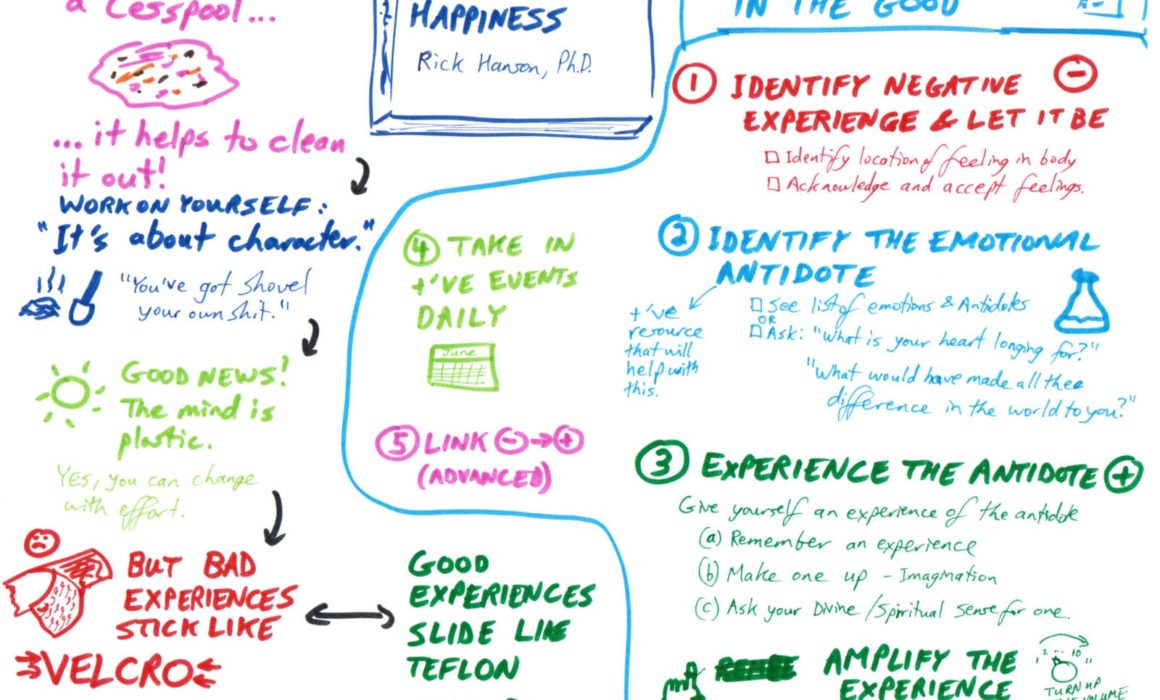
Dr. Fredrickson argues that Positivity is a lifestyle change that can result in a upward spiral of positivity with all the associated benefits. Masking the negative does not help, we actually need to focus on the positive – at least three positive events for every negative event.

I really appreciated Barabara’s message, however, the one part I will differ on is that in many environments we need to create trust and safety to reduce the background noise of negativity. This needs to happen in tandem with positivity.

You can learn more through Barabara’s website or book.

Update: Full Video is available on Agile Alliance Website.

Leave a Comment